

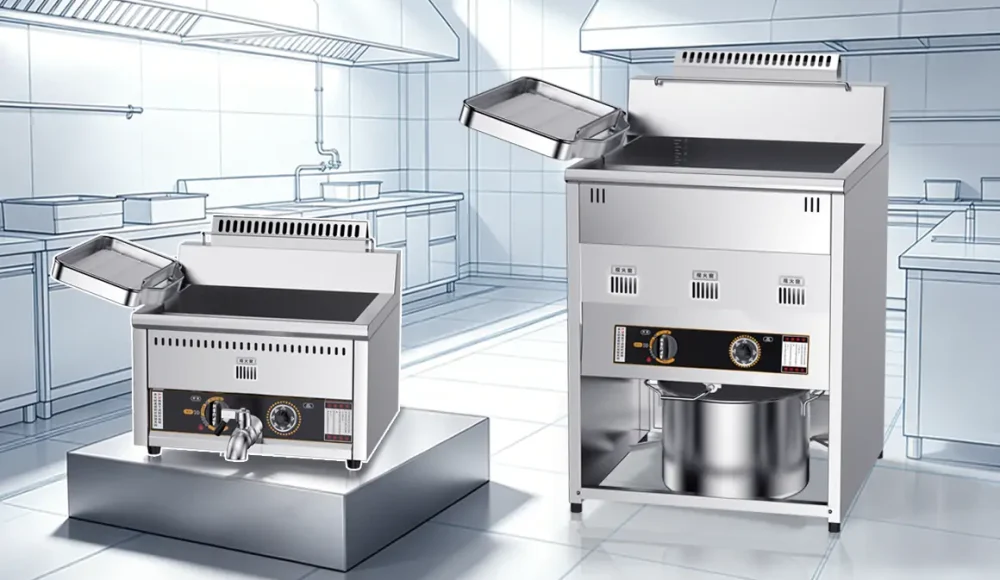
Choosing between a countertop fryer and a floor standing fryer looks simple until you consider how the kitchen actually operates. The available space, expected order volume, gas supply, ventilation, fryer capacity, heating power, and even whether the equipment needs to move during a renovation can all change the right choice.
For buyers sourcing from a commercial gas deep fryer manufacturer in China, the decision becomes even broader. A restaurant may be comparing a commercial natural gas fryer with a commercial propane gas fryer, while also deciding whether electric frying equipment would be easier to install. A distributor may instead need several configurations for different customer markets.
Shangbang manufactures commercial gas and electric deep fryers, including countertop and floor standing configurations, and provides OEM, ODM and private label manufacturing for distributors, wholesalers, restaurant groups and commercial kitchen projects. The company has operated since 2015 and manufactures commercial kitchen equipment in Guangzhou.
This guide looks at the decision from four practical angles: where the fryer will be used, how much frying capacity is actually needed, whether gas or electricity makes more sense, and what the kitchen ventilation and safety conditions require.
What are the main factors when choosing a commercial gas fryer?
The most useful way to choose a fryer is not to start with the biggest tank or the highest BTU number. Start with the kitchen.
A compact snack shop, food truck or small takeaway counter may benefit from a countertop gas fryer because valuable floor space remains available for preparation and storage. A restaurant with a permanent cooking line may have more reason to install a floor standing gas fryer, particularly when daily production requires larger oil capacity and higher sustained output.
The same principle applies to electric fryers. A 10–15L countertop electric fryer can be perfectly suitable for a smaller menu, while a 30–50L floor standing electric fryer makes more sense when frying becomes a major part of the production line.
For a B2B buyer, this distinction matters because the same fryer should not be treated as a universal solution for every customer. A commercial gas fryer supplier serving different markets usually needs countertop, floor standing, single-tank and double-tank configurations.
Countertop vs floor standing fryer: which kitchen is each designed for?
A countertop fryer is generally the more flexible choice when kitchen space, mobility or installation simplicity matters. It can sit on an existing workbench, be repositioned when the workflow changes, and work well in smaller foodservice operations.
A floor standing fryer takes a different approach. It becomes part of the cooking line rather than simply sitting on top of it. The larger cabinet structure provides a dedicated workstation and allows manufacturers to offer substantially larger oil capacities.
That makes the distinction particularly useful for a new restaurant.
A small burger shop that sells fries, chicken wings and a limited selection of fried snacks may not need a large floor unit. A fried chicken restaurant producing multiple batches throughout lunch and dinner service may quickly outgrow a countertop fryer.
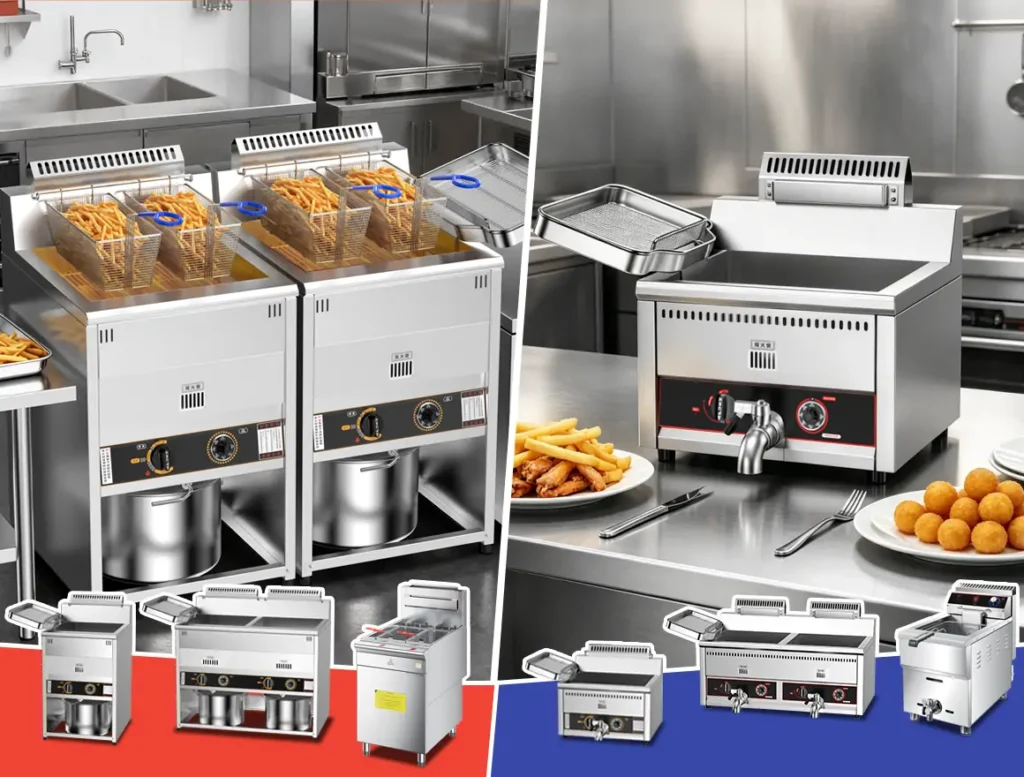
The gas side shows the same difference. Shangbang’s gas fryer range covers both countertop and free standing configurations for natural gas and LPG applications.
Countertop gas fryer options for smaller or flexible kitchens
For buyers looking for a countertop gas fryer wholesale solution, models such as the GF-0030 and GF-0031 are designed around propane operation and compact installation. The HW-RQ-WG001 series provides additional countertop configurations for both natural gas and propane, depending on the model.
The GF-0030 is a 17L single-tank propane gas fryer with 23,000 BTU/hr output. The GF-0031 uses two 17L tanks, with 23,000 BTU/hr per tank. Both use one-button switch ignition powered by two 1.5V D batteries.
The HW-RQ-WG001 range gives a buyer more flexibility when the local gas supply may be natural gas or propane. However, natural gas and propane are not interchangeable on a configured fryer. The gas type needs to be specified correctly for the intended market.
| Model | Configuration | Oil Capacity | Gas | BTU/hr | Voltage / Frequency / Power |
|---|---|---|---|---|---|
| GF-0030 | Countertop single tank | 17L / 4.42 gal | Propane | 23,000 | Battery ignition: 2 × 1.5V D batteries; gas heating |
| GF-0031 | Countertop double tank | 17L × 2 / 4.42 gal × 2 | Propane | 23,000 per tank | Battery ignition: 2 × 1.5V D batteries; gas heating |
| HW-RQ-WG001-A | Countertop single tank | 12L / 3.12 gal | Natural gas / Propane | 22,000 | gas heating |
| HW-RQ-WG001-B | Countertop single tank | 22.5L / 5.85 gal | Natural gas / Propane | 22,000 | gas heating |
| HW-RQ-WG001-C | Countertop single tank | 27L / 7.02 gal | Natural gas / Propane | 29,000 | gas heating |
| HW-RQ-WG001-D | Countertop double tank | 12L × 2 / 3.12 gal × 2 | Natural gas / Propane | 22,000 per tank | gas heating |
| HW-RQ-WG001-E | Countertop double tank | 22.5L × 2 / 5.85 gal × 2 | Natural gas / Propane | 22,000 per tank | gas heating |
For businesses where countertop space is the limiting factor, this range can be easier to integrate than a large floor unit.
When does a floor standing gas fryer make more sense?
A floor standing gas fryer manufacturer typically develops larger models for kitchens where frying is a dedicated production function rather than an occasional menu item.
The DG3, DG4 and DG5 illustrate how BTU output and oil capacity can scale together. DG3 and DG4 use the same 24L tank size but offer 90,000 and 120,000 BTU/hr respectively. DG5 increases the tank to 44L and reaches 150,000 BTU/hr.
That difference is not simply about making the machine “more powerful.” Higher heat input becomes meaningful when the fryer needs to recover temperature repeatedly after food is added during busy service.
| Model | Configuration | Oil Capacity | Gas | BTU/hr |
|---|---|---|---|---|
| DG3 | Floor standing single tank | 24L / 6.24 gal | NG / LPG | 90,000 |
| DG4 | Floor standing single tank | 24L / 6.24 gal | NG / LPG | 120,000 |
| DG5 | Floor standing single tank | 44L / 11.44 gal | NG / LPG | 150,000 |
| HW-RQ-WG002-A | Floor standing single tank | 36L / 9.1 gal | Natural gas / Propane | 29,000 |
| HW-RQ-WG002-B | Floor standing single tank | 45L / 11.7 gal | Natural gas / Propane | 34,000 |
| HW-RQ-WG002-C | Floor standing single tank | 72L / 18.72 gal | Natural gas / Propane | 59,000 |
| HW-RQ-WG002-D | Floor standing single tank | 90L / 23.4 gal | Natural gas / Propane | 68,000 |
| HW-RQ-WG002-E | Floor standing double tank | 36L × 2 / 9.1 gal × 2 | Natural gas / Propane | 29,000 per tank |
| HW-RQ-WG002-F | Floor standing double tank | 45L × 2 / 11.7 gal × 2 | Natural gas / Propane | 34,000 per tank |
The DG series also uses optional SIT710 or SIT820 multifunction proportional gas control valves. This type of gas-control architecture is worth considering when temperature regulation and burner modulation are important purchasing criteria rather than simply looking at the maximum BTU figure.
For buyers who want to understand how gas type, BTU and application affect fryer selection, Shangbang has previously covered this in “How to Choose the Right Commercial Gas Deep Fryer for Your Business: Natural Gas vs LPG, BTU & Application Guide 2026.”
How does fryer capacity affect restaurant output?
Capacity should be connected to actual production, not simply the number printed on the product specification sheet.
A 12L countertop fryer can be useful when the kitchen is preparing smaller batches throughout the day. But if the fryer is constantly waiting for oil temperature to recover, adding a second small fryer may not solve the workflow problem as efficiently as moving to a larger commercial fryer.
The opposite can also happen. Installing a 70L or 90L fryer in a kitchen that only sells a small number of fried products can consume valuable space and increase the amount of oil sitting in the equipment without providing a practical production benefit.
This is where electric floor standing fryers become an interesting comparison.
The EF001-JX01, EF001-JX02, EF001-JX03 and EF001-JX05 family covers 20L, 30L, 40L and 50L single-tank configurations, with electric heating systems ranging from 5KW to 9KW. For a restaurant that already has sufficient electrical capacity and wants a dedicated floor standing frying station, this provides a different route from high-BTU gas equipment.
| Model | Configuration | Oil Capacity | Voltage / Frequency | Rated Power |
|---|---|---|---|---|
| EF001-JX01 | Floor standing single tank | 20L | Not specified in supplied product data; customizable by project | 5–9KW range |
| EF001-JX02 | Floor standing single tank | 30L | Not specified in supplied product data; customizable by project | 5–9KW range |
| EF001-JX03 | Floor standing single tank | 40L | Not specified in supplied product data; customizable by project | 5–9KW range |
| EF001-JX05 | Floor standing single tank | 50L | Not specified in supplied product data; customizable by project | 5–9KW range |
Shangbang’s current electric fryer range also includes free standing 30L, 40L and 50L commercial models, as well as double-tank configurations. The published range is positioned for restaurants, fast food businesses, catering operations and other commercial kitchens.
For a kitchen that needs even more flexibility, the EF003-A1, EF003-A2 and EF003-A3 provide single-tank 30L, 40L and 50L configurations, while the EF003-A4 provides two 30L tanks.
| Model | Configuration | Oil Capacity | Voltage / Frequency | Rated Power |
|---|---|---|---|---|
| EF003-A1 | Floor standing single tank | 30L | Not specified in supplied product data | Not specified in supplied product data |
| EF003-A2 | Floor standing single tank | 40L | Not specified in supplied product data | Not specified in supplied product data |
| EF003-A3 | Floor standing single tank | 50L | Not specified in supplied product data | Not specified in supplied product data |
| EF003-A4 | Floor standing double tank | 30L × 2 | Not specified in supplied product data | Not specified in supplied product data |
For a restaurant equipment buyer, the useful comparison is therefore not simply gas versus electric. It is:
How much food needs to be fried, how quickly must batches recover, how much floor space is available, and what utilities are already installed?
Commercial natural gas fryer or commercial propane fryer?
The choice between natural gas and propane should be made from the site’s actual gas supply and the fryer configuration required for that market.
A commercial natural gas fryer can be appropriate where a fixed natural gas connection is already available. A commercial propane gas fryer can make more sense where propane cylinders or a dedicated propane supply are part of the site’s infrastructure.
The HW-RQ-WG001 and HW-RQ-WG002 families can be configured for natural gas or propane, but the two gas types cannot simply be mixed on the same configured machine.
The same consideration applies to the DG3, DG4 and DG5 NG/LPG configurations. The correct gas configuration should be confirmed before quotation, production and installation.
For a commercial propane fryer supplier, this is particularly important because customers in different countries can have different gas pressures, connection standards and installation requirements.
The existing Shangbang range specifically separates commercial gas fryers into countertop and free standing applications and identifies natural gas and LPG/propane configurations for different market requirements.
Where do countertop and floor standing electric fryers fit?
Gas is not automatically the answer simply because a kitchen has a high frying demand.
Electric fryers can be attractive where electrical capacity is available and the kitchen wants a simpler installation arrangement without a dedicated gas connection. Countertop electric fryers also make sense for businesses where mobility and limited space matter.
The EF011-B1, EF011-B2 and EF011-B3 range is positioned as a countertop electric fryer option with 3KW to 3.5KW configurations and timer-controlled operation.
| Model | Configuration | Oil Capacity | Voltage / Frequency | Rated Power |
|---|---|---|---|---|
| EF011-B1 | Countertop single tank | Not specified in supplied product data | Not specified in supplied product data | 3KW |
| EF011-B2 | Countertop single tank | Not specified in supplied product data | Not specified in supplied product data | 3.25KW |
| EF011-B3 | Countertop single tank | Not specified in supplied product data | Not specified in supplied product data | 3.5KW |
For customers wanting more automation, the EF021-C and EF022-C are 12L and 15L single-tank automatic-lifting smart electric fryers, while EF023-C and EF024-C provide 12L × 2 and 15L × 2 double-tank configurations.
| Model | Configuration | Oil Capacity | Voltage / Frequency | Rated Power |
|---|---|---|---|---|
| EF021-C | Countertop single tank | 12L | Not specified in supplied product data | Not specified in supplied product data |
| EF022-C | Countertop single tank | 15L | Not specified in supplied product data | Not specified in supplied product data |
| EF023-C | Countertop double tank | 12L × 2 | Not specified in supplied product data | Not specified in supplied product data |
| EF024-C | Countertop double tank | 15L × 2 | Not specified in supplied product data | Not specified in supplied product data |
This type of equipment can be useful for restaurants that want separate frying zones without committing to a large floor standing fryer.
Shangbang also manufactures countertop electric fryer ranges such as the EF014, EF015 and EF016 in 10L, 12L and 15L configurations.
What about ventilation and kitchen safety?
Ventilation should be considered before deciding between a gas fryer and an electric fryer.
A commercial gas fryer creates a combustion process in addition to the heat and cooking vapors produced during frying. The kitchen therefore needs an appropriate exhaust and ventilation arrangement designed for gas cooking equipment. Local gas regulations, exhaust requirements, gas pressure and installation standards should be checked before equipment is ordered.
An electric fryer does not use combustion gas, which can make it easier to integrate into certain kitchen layouts. That does not mean electric frying is ventilation-free. Frying still produces heat, grease-laden vapors and cooking odors, so a commercial extraction system may still be required.
For a new restaurant, this is one reason it is useful to plan the fryer together with the entire kitchen instead of purchasing the fryer as an isolated appliance.
A new restaurant may need more than a fryer
This is where a commercial kitchen equipment manufacturer can provide more value than a supplier selling only one machine.
A new restaurant may need a fryer, flat-top griddle, breading or coating station, marinating equipment, food warming cabinet, noodle cooker and other supporting equipment. Buying each item from unrelated suppliers can create differences in materials, dimensions, packaging, electrical specifications and after-sales support.
Shangbang’s product range includes commercial griddles, food warming display cabinets, marinating machines and other supporting foodservice equipment in addition to commercial gas and electric fryers.
For a restaurant project, this allows the fryer to be considered as part of the workflow rather than as an isolated product.
For example, a fried chicken operation may need the fryer positioned close to the coating station and marinating preparation area, while the warming cabinet needs to be placed where cooked products can move quickly toward order assembly.
The exact product mix depends on the menu, but the principle is simple: the fryer should fit the kitchen workflow, not force the entire kitchen to work around the fryer.
What should B2B buyers compare when sourcing from a manufacturer?
For wholesalers and restaurant equipment distributors, the purchasing question is different from that of a restaurant operator.
A distributor may need one countertop propane fryer, one countertop natural gas fryer, several floor standing gas models and several electric configurations for different customer segments. In that situation, a commercial gas fryer manufacturer should be able to discuss gas type, tank capacity, BTU, electrical requirements for ignition or controls, structure, packaging, labeling and OEM requirements together.
Shangbang’s current manufacturing information states that it supports OEM and ODM manufacturing, private labeling, custom voltage standards, product structure customization, logo branding and packaging customization. Its production and quality-control process covers material inspection, heating performance testing, leakage and safety testing, long-term stability testing and packaging inspection.
That is especially relevant when the buyer is building a product range rather than ordering one machine.
If you are comparing suppliers, the earlier Shangbang article “How to Choose a Reliable Commercial Deep Fryer Manufacturer in China (2026 Guide)” goes deeper into manufacturer evaluation from the sourcing side.
Countertop or floor standing: a practical decision
There is no universal answer because the two configurations solve different operating problems.
A countertop fryer is usually worth considering when the kitchen has limited floor space, needs flexibility, serves moderate frying volumes or operates from a food truck, snack counter or compact restaurant.
A floor standing fryer becomes more relevant when frying is a major part of production, the kitchen has a permanent cooking line, larger oil capacity is required, or the operator needs multiple independent frying stations.
Gas adds another layer. A commercial natural gas fryer is closely tied to the site’s natural gas infrastructure, while a commercial propane gas fryer needs the appropriate propane supply and correctly configured equipment.
Electric equipment becomes another viable route when the site has sufficient electrical capacity and the operator prefers an electric heating system.
The most sensible choice is therefore not determined by the fryer label alone. It comes from matching capacity + output + utility + space + ventilation + workflow + future demand.
That is also why a manufacturer with both gas and electric commercial fryer ranges can be useful for B2B buyers. The same restaurant project can require completely different equipment depending on its location and operating model.
FAQs
Is a countertop gas fryer better for a small restaurant?
A countertop gas fryer can be a practical choice for a small restaurant when floor space is limited and frying demand is moderate. The actual choice should still consider gas availability, ventilation, menu volume and required oil capacity.
When should a restaurant choose a floor standing gas fryer?
A floor standing gas fryer is generally more suitable when frying is a major part of daily production and the kitchen needs larger oil capacity, a dedicated frying station or higher sustained output.
What is the difference between a natural gas fryer and a propane fryer?
The primary difference is the gas supply and corresponding fryer configuration. Natural gas and propane should not be treated as interchangeable without the correct equipment configuration and installation requirements.
Is a commercial electric fryer a good alternative to a gas fryer?
Yes. A commercial electric fryer can be a practical alternative where sufficient electrical capacity is available and the kitchen prefers an electric heating system. Countertop and floor standing electric models can cover different production requirements.
Can a manufacturer supply a complete commercial kitchen equipment package?
A manufacturer with a broader commercial kitchen equipment range may be able to supply multiple categories together. Shangbang manufactures commercial gas and electric fryers and also offers supporting equipment such as commercial griddles, food warming cabinets and marinating machines, with OEM and ODM solutions for B2B projects.