

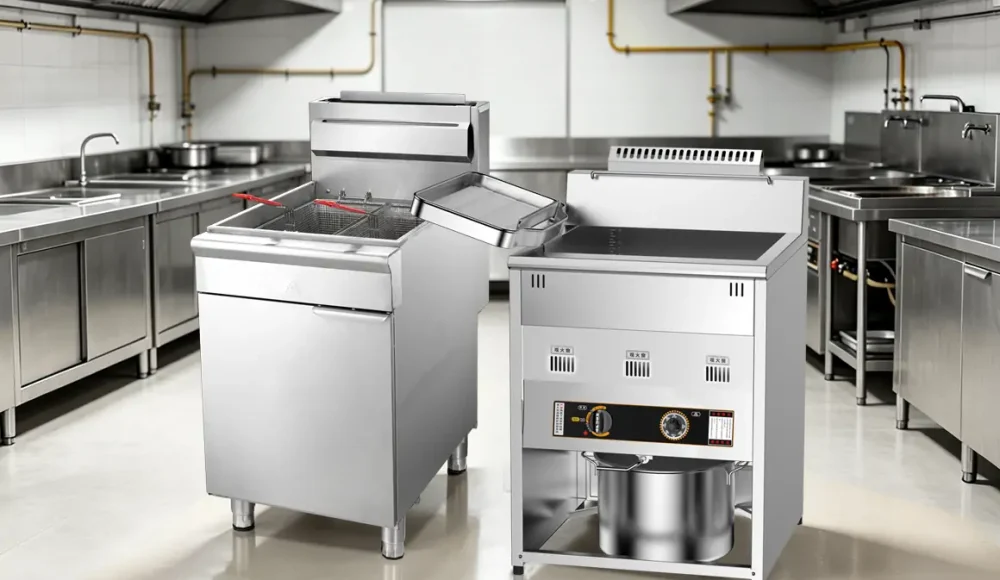
Choosing a commercial gas deep fryer is not simply about selecting a machine with a large oil capacity or higher heating power.
For restaurants, fast food chains, food trucks, catering businesses, and commercial kitchens, the right fryer directly affects frying consistency, energy cost, production efficiency, and long-term operating stability.
The best commercial gas deep fryer depends on several practical factors:
- what fuel source is available in your location
- how many hours the fryer operates every day
- how much food needs to be produced during peak periods
- whether your kitchen requires mobility or fixed installation
- whether you need a simple production fryer or a customized OEM solution
A natural gas fryer and an LPG gas fryer can both deliver excellent commercial performance, but they are designed for different working environments.
As a commercial gas fryer manufacturer in China, Shangbang has worked with global restaurant operators, distributors, and OEM customers to develop different fryer solutions based on real kitchen requirements.
From small takeaway shops to high-volume fried chicken restaurants, choosing the correct gas fryer configuration is not about buying the biggest machine.
It is about matching the equipment with the actual production demand.
How to Choose a Commercial Gas Deep Fryer Based on Your Business Environment?
The correct commercial gas deep fryer should always match the operating environment.
Many buyers focus only on specifications such as oil capacity, burner power, or stainless steel appearance. However, professional buyers usually evaluate the complete working condition before selecting a fryer.
A restaurant operating 12 hours per day has completely different requirements from a small snack shop that fries several batches occasionally.
A food truck requires different fuel flexibility compared with a fixed restaurant kitchen.
A hotel kitchen requires different recovery speed compared with a small takeaway business.
This is why commercial fryer selection should start from application, not from product appearance.
When Should You Choose a Gas Fryer Instead of an Electric Fryer?
A commercial gas fryer is usually preferred when the business requires higher heating output, flexible installation, or lower energy cost based on local fuel conditions.
Although Shangbang specializes in commercial electric fryer manufacturing as well, many customers compare electric and gas solutions before making purchasing decisions.
The choice depends mainly on the working environment.
Gas Fryer for Food Trucks and Mobile Catering Operations
For mobile businesses, electricity availability can become a major limitation.
Food trucks, outdoor catering stations, temporary event kitchens, and mobile snack businesses often require independent energy solutions.
In these situations, LPG gas fryer systems are commonly selected because they provide:
- flexible installation
- easy fuel replacement
- outdoor operating capability
- strong heating performance without depending on high-power electrical supply
A commercial outdoor gas fryer is especially suitable for businesses that move between different locations.
For these customers, a propane fryer or LPG gas fryer can provide more flexibility compared with fixed electrical equipment.
Gas Fryer for Restaurants With High Daily Production
Restaurants with continuous frying demand usually care about:
- heating recovery speed
- oil temperature stability
- production capacity
- energy cost during long operation hours
A commercial gas deep fryer can provide strong heating output through high BTU burner systems.
This makes it suitable for:
- fried chicken restaurants
- fast food chains
- hotels
- catering kitchens
- large takeaway businesses
When frozen food enters hot oil, the oil temperature naturally drops.
The ability to recover temperature quickly determines whether the next batch can maintain the same quality.
This is why many professional buyers evaluate BTU output rather than only looking at oil tank size.
When Electric Fryers Are More Suitable?
Gas fryers are not always the only solution.
In urban areas where electricity supply is stable and installation requirements are strict, commercial electric fryers are still widely used.
Electric systems can provide:
- precise temperature control
- simple installation
- cleaner kitchen environment
- easier maintenance
For example, countertop electric fryer models are commonly selected by smaller restaurants, cafes, and compact kitchens.
The key point is not choosing gas or electric blindly.
The correct equipment should match the business model.
When buyers evaluate fryer performance, temperature stability becomes another important factor. As explained in our previous engineering discussion about why temperature control becomes the hidden cost driver behind commercial fryer operation, stable temperature management directly affects oil consumption, food consistency, and equipment lifespan.
Natural Gas Fryer vs LPG Gas Fryer: Which Fuel Type Is Better?
The answer depends on your local fuel conditions.
There is no universal winner between natural gas and LPG.
A professional commercial gas fryer manufacturer usually recommends fuel selection based on installation environment rather than simply promoting one type.
Natural Gas Deep Fryer: Best Choice for Fixed Commercial Kitchens
A natural gas fryer is commonly used in permanent restaurant locations where gas pipelines are already available.
Typical applications include:
- restaurants
- hotels
- central kitchens
- fast food chains
- commercial food production facilities
Advantages include:
- stable fuel supply
- convenient long-term operation
- suitable for high-volume kitchens
- lower dependence on fuel replacement
A commercial natural gas fryer is usually a good choice for businesses operating in the same location for many years.
LPG Gas Fryer: Flexible Solution for Mobile and Independent Operations
An LPG gas fryer uses bottled liquefied petroleum gas and is widely used where natural gas pipelines are unavailable.
Common applications include:
- food trucks
- outdoor catering
- temporary kitchens
- small restaurants
- remote locations
Advantages include:
- flexible installation
- easy fuel access
- suitable for mobile operation
However, LPG and natural gas systems are not interchangeable.
The burner design, gas pressure, and valve adjustment must match the correct fuel type.
Using the wrong gas source without proper adjustment can affect:
- combustion efficiency
- safety performance
- heating stability
A reliable commercial gas fryer factory should provide the correct configuration according to the customer’s local fuel standard.
What Is BTU and Why Does It Matter When Choosing a Commercial Gas Fryer?
When selecting a commercial gas deep fryer, many buyers focus on oil capacity first.
However, professional restaurant operators usually pay closer attention to another important specification: BTU output.
BTU (British Thermal Unit) represents the heating energy produced by the burner system.
In simple terms:
Higher BTU means stronger heating capability and faster temperature recovery after food is added.
For a commercial kitchen, this matters because every batch of frozen food temporarily reduces oil temperature.
If the fryer cannot recover quickly:
- frying time becomes longer
- food absorbs more oil
- product texture becomes inconsistent
- peak-hour production slows down
For example, a restaurant serving hundreds of fried chicken portions every day requires a completely different heating system compared with a small snack shop producing a few batches per hour.
That is why choosing the right BTU level is not about selecting the highest number.
It is about matching heating capacity with daily production requirements.
Low BTU vs High BTU Commercial Gas Fryer: How Should Restaurants Choose?
Different businesses require different heating output.
A small restaurant does not necessarily need a 150,000 BTU fryer, while a busy fried chicken chain may struggle with a low-output model.
The correct BTU selection should consider:
- food type
- frying volume
- peak-hour demand
- oil tank capacity
- operating hours
30,000–60,000 BTU Gas Fryer: Efficient Solution for Small and Medium Businesses
For businesses with moderate frying demand, a lower BTU commercial gas fryer can provide a practical balance between performance and investment.
Typical applications:
- cafes
- takeaway shops
- small restaurants
- snack stores
- compact commercial kitchens
Shangbang’s HW-RQ-WG001, HW-RQ-WG002, HW-RQ-WG003, and HW-RQ-WG004 gas fryer series are designed for customers who need reliable commercial frying performance while controlling equipment investment.
These models provide:
- 30,000–60,000 BTU heating capability
- independent mechanical temperature control
- countertop and floor-standing options
- simple operation structure
- flexible configuration for different kitchen layouts
For many small and medium food businesses, a stable and easy-to-maintain system is more valuable than purchasing an oversized fryer.
A properly matched gas fryer can reduce unnecessary energy consumption while maintaining consistent food quality.
These models are suitable for:
- restaurant fryer applications
- takeaway businesses
- small fast food operations
- catering projects
90,000–150,000 BTU Commercial Gas Fryer: Designed for High-Volume Production
High-output kitchens require stronger recovery performance.
When hundreds of portions are produced during lunch or dinner peaks, the fryer must recover oil temperature quickly after every batch.
Shangbang GF3, GF4, and GF5 freestanding commercial gas fryer series are developed for high-volume commercial kitchens.
The series features:
- 90,000–150,000 BTU/hr heating output
- 24L and 44L oil capacity options
- high-efficiency gas heating system
- SIT710 or SIT820 multifunction gas control valve
- adjustable temperature control
- heavy-duty commercial structure
These commercial gas deep fryer models are commonly suitable for:
- fried chicken chains
- large fast food restaurants
- hotels
- catering companies
- central kitchen production
The purpose of a high BTU fryer is not simply to heat oil faster.
The real value is maintaining production stability during continuous operation.
When a restaurant serves hundreds of customers daily, every small temperature delay can accumulate into:
- longer waiting time
- inconsistent product quality
- increased labor pressure
A professional commercial gas fryer manufacturer designs the complete heating system, not just the burner.
The burner power, oil tank design, temperature sensing system, and safety control must work together.
Shangbang Commercial Gas Fryer Solutions: Matching Equipment With Real Kitchen Requirements
A common mistake during purchasing is choosing equipment based only on price or maximum capacity.
Experienced buyers usually evaluate:
- expected daily output
- available fuel type
- kitchen space
- maintenance requirements
- future business expansion
At Shangbang, we do not recommend the same gas fryer model for every customer.
As a commercial gas fryer manufacturer in China, our approach is based on application matching.
The same customer may need completely different solutions depending on whether they operate:
- a small takeaway restaurant
- a fried chicken chain
- a hotel kitchen
- a food truck business
- a private-label equipment brand
GF3, GF4, GF5 Freestanding Commercial Gas Fryer Series: Built for Heavy-Duty Kitchens
For customers requiring high-volume frying capability, the GF3, GF4, and GF5 series provide a professional solution.
The freestanding structure provides:
- larger oil capacity
- stronger production capability
- easier integration into commercial kitchen lines
The gas control system uses professional components such as SIT710 or SIT820 multifunction gas control valves.
This helps provide:
- stable gas adjustment
- safer operation
- accurate heating control
With different oil tank capacity options, these models can support different restaurant production levels.
For example:
A single-location fried chicken restaurant may select a medium-capacity configuration.
A multi-store fast food operator may require higher-output models to maintain consistent production during peak hours.
This is where working with a real commercial gas fryer factory becomes important.
A factory understands not only how to manufacture the machine but also how different kitchen environments affect long-term performance.
HW-RQ-WG001–WG004 Gas Fryer Series: Flexible Commercial Solution With Lower Investment
Not every business requires maximum output.
Many restaurants need a dependable fryer that provides commercial performance without unnecessary investment.
The HW-RQ-WG001–WG004 series focuses on:
- practical operation
- easy maintenance
- flexible installation
- cost-effective commercial use
Available configurations include:
- countertop gas fryer options
- floor-standing gas fryer options
- different tank sizes
- mechanical temperature control
These models are suitable for:
- small restaurants
- cafes
- snack businesses
- takeaway stores
- catering companies starting their business
For distributors and wholesalers, this type of product line is also valuable because it covers a wider customer range.
A professional commercial gas fryer supplier should provide different models rather than only one specification.
Different markets have different requirements.
Why Fuel Type, BTU, and Structure Must Be Considered Together?
A commercial gas fryer is a complete cooking system.
Fuel type determines installation flexibility.
BTU determines heating capability.
Tank structure determines production capacity.
Temperature control determines frying consistency.
Ignoring one factor can create problems later.
For example:
A fryer with high BTU but unsuitable capacity may waste energy.
A large tank without enough heating power may recover slowly.
A low-cost fryer without proper safety components may create maintenance problems.
This is why experienced buyers usually evaluate the entire system instead of comparing only one specification.
The same principle applies when choosing a commercial deep fryer manufacturer.
Manufacturing experience, engineering capability, and quality control determine whether the equipment can perform reliably after months or years of commercial use.
Natural Gas Fryer or LPG Gas Fryer: Which Fuel Type Fits Your Commercial Kitchen?
Choosing between a natural gas fryer and an LPG gas fryer is not only a question of fuel type. For restaurant owners, distributors, and commercial kitchen equipment buyers, the right decision depends on local energy availability, installation conditions, operating costs, and future business expansion.
A commercial gas deep fryer is designed for high-volume frying environments where fast recovery, stable heating, and long working hours are required. Compared with many electric models, gas fryers can provide strong heating output with rapid temperature recovery, making them widely used in fried chicken restaurants, fast food chains, outdoor catering businesses, and large commercial kitchens.
However, natural gas and LPG systems have different characteristics.
A professional commercial fryer manufacturer should not simply recommend one fuel type for every customer. The correct configuration depends on where and how the equipment will operate.
At Shangbang, we usually evaluate:
local fuel infrastructure
restaurant location
daily frying volume
installation environment
maintenance convenience
future expansion requirements
This is why fuel selection should be considered before selecting the final fryer model.
Natural Gas Fryer: Best Choice for Fixed Commercial Kitchen Operations
A natural gas fryer is usually the preferred solution for restaurants that have a permanent gas supply system.
Natural gas is commonly supplied through underground pipelines or commercial gas networks, which means the restaurant does not need to regularly replace fuel cylinders.
For businesses with long operating hours, this creates several advantages:
stable fuel supply
lower daily management requirements
convenient continuous operation
better suitability for high-volume frying
This makes natural gas fryers popular in:
fried chicken chains
fast food restaurants
shopping mall food courts
hotel kitchens
large catering kitchens
A restaurant operating 8–16 hours every day usually benefits from a fixed natural gas connection because fuel management becomes easier.
For example, a busy fried chicken restaurant may operate several restaurant deep fryer units at the same time. In this situation, replacing LPG cylinders frequently can interrupt workflow, while a natural gas system can provide a more continuous energy supply.
However, natural gas requires proper installation conditions.
The kitchen must already have:
commercial natural gas connection
correct gas pressure
professional gas pipeline installation
suitable ventilation system
For locations without existing natural gas infrastructure, LPG may become a more practical solution.
LPG Gas Fryer: Flexible Solution for Mobile and Independent Businesses
An LPG gas fryer uses liquid petroleum gas stored in cylinders or tanks.
Compared with natural gas, LPG provides much higher flexibility because it does not depend on fixed pipeline systems.
This makes LPG gas fryers widely used for:
food trucks
mobile catering
outdoor events
temporary kitchens
small independent restaurants
remote areas
businesses with unstable electricity supply
For example, a food truck operating at different locations cannot rely on permanent natural gas infrastructure. In this case, an LPG commercial fryer provides the ability to move and operate independently.
Many customers looking for a food truck fryer supplier or outdoor cooking equipment supplier prefer LPG because installation is simpler.
However, LPG requires more attention to fuel management:
gas cylinder replacement
storage safety
pressure regulation
daily fuel planning
For high-volume restaurants, the operation team needs to ensure enough LPG supply is available during peak hours.
Natural Gas Fryer vs LPG Gas Fryer Comparison
| Comparison Factor | Natural Gas Fryer | LPG Gas Fryer |
|---|---|---|
| Fuel supply | Fixed pipeline supply | Gas cylinder/tank supply |
| Installation | Requires natural gas connection | More flexible installation |
| Mobility | Limited | Suitable for mobile operation |
| Best application | Restaurants, chains, hotels | Food trucks, outdoor kitchens, independent stores |
| Fuel management | Easier for long operation | Requires cylinder planning |
| Initial setup | Higher if pipeline is unavailable | Usually simpler |
| Continuous frying | Excellent for high-volume kitchens | Good when fuel supply is sufficient |
| Location flexibility | Lower | Higher |
The important point is that neither fuel type is universally better.
The right choice depends on the operating environment.
A reliable commercial gas fryer manufacturer should help buyers select according to application rather than simply selling the highest-power model.
What Commercial Gas Fryer Capacity Does Your Kitchen Actually Need?
Oil capacity directly affects how much food a fryer can process during continuous operation.
However, the correct capacity depends on the relationship between:
oil volume
food loading amount
recovery speed
daily frying hours
menu type
A larger oil tank does not automatically mean higher efficiency.
The fryer must also have enough heating power to recover temperature quickly after frozen food enters the oil.
Small Commercial Gas Fryer Applications: 10L–20L Range
Smaller commercial fryers are usually suitable for:
small restaurants
cafes
snack shops
independent takeaway stores
small foodservice businesses
These kitchens normally have:
lower frying frequency
smaller customer flow
limited installation space
For these applications, a compact commercial countertop fryer or small gas fryer can provide enough production capacity without unnecessary investment.
Typical products include:
fried chicken wings
French fries
onion rings
fried snacks
small seafood products
The advantage of smaller fryers is:
lower initial cost
easier operation
simpler maintenance
smaller footprint
However, businesses planning future expansion should consider whether the capacity can support increasing demand.
Medium Commercial Gas Fryer Applications: 20L–40L Range
Medium-capacity fryers are commonly used in:
fast food restaurants
fried chicken shops
restaurant chains
food courts
catering businesses
This capacity range provides a balance between production output and operating cost.
A restaurant producing hundreds of fried food portions daily needs enough oil volume to maintain temperature stability.
When frozen food enters the oil, temperature naturally drops.
A properly matched fryer can recover temperature quickly and maintain consistent frying quality.
This is where BTU output becomes important.
A 30L–40L fryer with insufficient heating power may still struggle during peak hours.
Large Commercial Gas Fryer Applications: 40L+ High Volume Production
Large-capacity commercial gas fryers are designed for businesses with continuous frying demand.
Typical applications include:
large fried chicken chains
central kitchens
hotel catering departments
industrial foodservice operations
large restaurants
These kitchens often operate:
8–16 hours per day
multiple frying cycles continuously
high-volume food production
For these applications, equipment reliability becomes more important than initial purchase price.
A high-volume fryer requires:
strong burner performance
stable gas control system
durable stainless steel construction
easy oil management
fast recovery after loading
This is why many professional buyers choose floor-standing gas fryers rather than small countertop models.
Open Pot, Deep Tank and Cold Zone Design: Which Fryer Structure Fits Better?
Besides capacity, tank design also changes frying performance.
Different fryer structures are designed for different food categories.
Standard Open Tank Commercial Fryer
Standard tank fryers are commonly used for:
French fries
snacks
small fried products
general restaurant frying
They provide simple operation and easy cleaning.
For businesses with different menu items, this type offers flexibility.
Long Tank Commercial Fryer
Long tank fryers are designed for larger or longer food products.
Typical applications include:
long chicken strips
fish fillets
large seafood products
specialty fried foods
The longer oil area allows food products to be positioned properly without overcrowding.
Deep Tank Cold Zone Commercial Fryer
Cold zone technology is especially important for high-volume frying.
During operation, food particles naturally fall into the lower cooler area instead of remaining around the heating zone.
This helps:
reduce burnt crumbs
keep oil cleaner
extend oil usability
protect heating components
For restaurants that fry continuously every day, cold zone structure can significantly improve operating efficiency.
This topic is also closely connected with another engineering factor we discussed previously: how sediment and food particles can damage fryer heating elements over long-term operation. Managing oil cleanliness is not only about food quality, but also about protecting the heating system itself.
Floor Standing Gas Fryer vs Countertop Fryer: Which One Fits Your Business?
The choice between countertop and floor-standing equipment depends heavily on production volume.
Countertop Commercial Fryer
Countertop models are suitable for:
small kitchens
limited space restaurants
cafes
snack bars
small food businesses
Advantages:
compact installation
lower investment
easy movement
simple operation
Floor Standing Commercial Gas Fryer
Floor-standing fryers are designed for:
high-volume restaurants
fried chicken chains
commercial kitchens
large catering operations
Advantages:
larger oil capacity
higher BTU output
faster recovery
continuous production capability
For businesses expecting long-term growth, investing in a larger commercial fryer system can provide better operational flexibility.
How to Select a Reliable Commercial Gas Fryer Manufacturer for Long-Term Business
A good fryer supplier should not only provide competitive pricing.
Long-term cooperation depends on:
consistent product quality
stable production capacity
OEM customization ability
technical communication
after-sales support
For distributors and brand owners, the supplier behind the equipment directly affects their market reputation.
A low-cost fryer may reduce purchasing cost initially, but unstable quality can create:
customer complaints
replacement costs
maintenance issues
brand damage
This is why many experienced buyers evaluate manufacturers instead of simply comparing models.
FAQ: Commercial Gas Fryer Buying Questions
Q1: Should I choose a natural gas fryer or LPG gas fryer?
It depends on your local conditions. Natural gas fryers are usually better for fixed restaurants with stable pipeline supply, while LPG gas fryers provide more flexibility for food trucks, outdoor kitchens, and locations without natural gas infrastructure.
Q2: Is a higher BTU commercial fryer always better?
Not always. BTU should match your production requirements. A fryer with excessive heating capacity may increase cost, while insufficient BTU can slow recovery speed during busy periods.
Q3: What size commercial gas fryer is suitable for a fried chicken restaurant?
Small stores may use compact models, while busy fried chicken restaurants usually require larger oil capacity and higher BTU floor-standing fryers to maintain continuous production.
Q4: Can a natural gas fryer use LPG?
Not directly. Gas type conversion requires correct burner, nozzle, and pressure adjustments. Always confirm fuel specifications with the manufacturer before installation.
Q5: Why should restaurants buy from a commercial fryer factory instead of a trading company?
A direct factory can provide deeper technical support, OEM customization, production quality control, and long-term supply stability.