

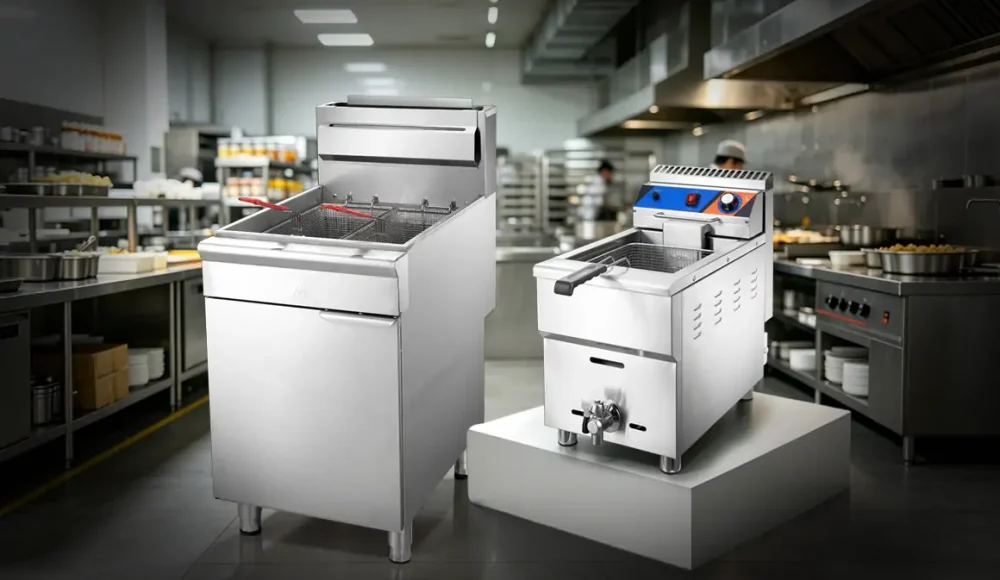
Choosing a commercial gas deep fryer is not simply a matter of looking at oil capacity or finding the lowest factory quotation. For distributors, restaurant equipment wholesalers, private-label brands, and foodservice projects, the more important question is whether the fryer configuration actually matches the local gas supply, kitchen workload, target selling price, and expected service life.
From the perspective of a commercial gas deep fryer manufacturer in China, this is where many purchasing decisions become difficult. Two fryers can look almost identical from the outside while having very different internal components, heating systems, gas controls, material thickness, ignition systems, and expected maintenance costs.
Shangbang has been manufacturing commercial kitchen equipment since 2015, with a 20,000 m² production facility, CNC sheet-metal processing, assembly, testing and OEM/ODM capabilities. The company manufactures both gas and electric commercial fryers for restaurants, distributors, wholesalers and private-label customers, with natural gas and LPG configurations available according to the target market.
For buyers comparing a commercial gas fryer factory, natural gas deep fryer manufacturer, or propane gas deep fryer manufacturer, the practical approach is to look beyond the quotation and understand what is actually inside the machine.
What Makes a Commercial Gas Deep Fryer Suitable for Real Commercial Use?
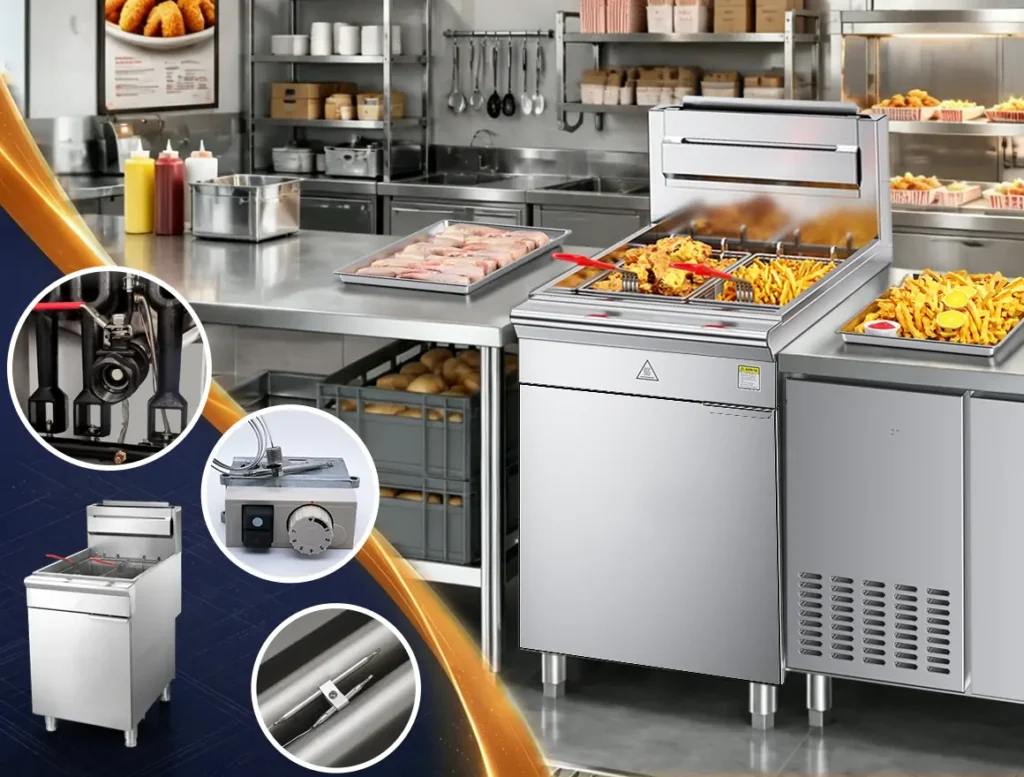
A commercial gas deep fryer is a complete heating and control system rather than simply a stainless steel tank with burners underneath. Its performance depends on how the oil tank, heat exchanger or heating tubes, burner assembly, gas valve, thermostat, ignition system, flame protection and cabinet structure work together.
In a busy restaurant, the fryer may operate for many hours each day. Frozen food is added repeatedly, oil temperature drops, the heating system responds, and the fryer has to recover quickly enough for the next batch. A machine that performs well during a short factory demonstration may behave very differently after several hours of continuous production.
That is why Shangbang approaches gas fryer manufacturing around application requirements rather than one universal configuration. A small snack shop may need a compact countertop gas fryer with modest BTU output, while a fried chicken restaurant or high-volume foodservice kitchen may require a floor standing gas fryer with a much larger oil tank and substantially higher heating capacity.
Natural Gas or Propane Gas Fryer: Which Fuel Configuration Fits Your Market?
The fuel decision should be made according to the gas infrastructure available at the installation location. Natural gas and propane are not simply two names for the same fuel, and a fryer configured for one gas type should not be casually connected to another.
A natural gas deep fryer is generally more practical where a stable natural gas pipeline is already available. Restaurants with fixed commercial kitchens and established gas infrastructure may prefer this arrangement because fuel supply is integrated into the building.
A propane gas deep fryer can be more flexible for locations without a natural gas pipeline. It is particularly relevant to certain mobile, temporary, outdoor, catering and independent foodservice applications where bottled or tank-supplied propane is easier to obtain.
The important point for distributors is not to mix these configurations during procurement. The gas valve, burner setup and related components must be selected for the specified fuel.
Shangbang’s gas fryer range supports natural gas and LPG configurations according to model and market requirements, and the company advises buyers to confirm the required gas configuration when requesting a quotation.
What Components Are Inside a Commercial Gas Fryer?
A reliable commercial gas fryer is built from many components that have to work together under heat, oil contamination and repeated daily operation.
The oil tank is the part buyers see most easily, but it is not necessarily the component that determines the overall reliability of the machine. The burner system determines how heat enters the fryer, while the gas valve controls the fuel supply. The thermostat or temperature-control system determines when additional heat is required, and the ignition and flame-protection system help ensure that the burner operates within its designed conditions.
There is also a practical difference between a low-cost component and a commercial-duty component. A gas valve may appear to perform the same basic function, but its durability, adjustment range, temperature resistance and compatibility with the intended gas system can be very different.
This is one reason Shangbang does not position its gas fryers purely around the lowest factory price. The company states that its manufacturing process includes raw-material inspection, heating-performance testing, leakage and safety testing, long-term stability testing and final inspection.
For a B2B buyer, the useful question is therefore not simply, “How much does this fryer cost?” It is “What components am I paying for, and what problem are those components designed to prevent?”
Why Does the Price of a Gas Fryer Vary So Much Between Factories?
A very low quotation does not automatically mean that the supplier is inefficient, and a high quotation does not automatically mean that the fryer is better. Price needs to be understood through the components, manufacturing process and target market behind it.
In the commercial fryer market, a buyer may see three visually similar machines with very different quotations. One may use a basic burner and simple control system, another may use upgraded valves and heavier materials, while a third may be designed around a higher-duty heating and safety system.
The difference becomes easier to understand when the fryer enters a real restaurant.
A machine used for two or three hours a day has a completely different workload from one operating through a twelve-hour service period. A fryer used for frozen chicken during continuous peak production has a different thermal load from one preparing occasional fries or snacks.
This is why Shangbang’s position as a factory is important for OEM and wholesale buyers. The company does not simply purchase finished fryers for resale. Its production system includes sheet-metal processing, CNC manufacturing, assembly and quality-control procedures. That gives the manufacturer greater control over how the components and structure are matched.
The goal is not to make every component as expensive as possible. The goal is to choose components whose durability and performance are appropriate for the intended commercial workload.
Flame Protection, Ignition and Gas Control Are Not Minor Details
Gas-fryer safety begins with reliable ignition and flame control.
Shangbang’s different gas fryer families use different control approaches depending on the intended product positioning. The DG series can be configured with SIT710 or SIT820 multifunctional proportional gas-control valves. These systems allow more controlled gas adjustment compared with a very basic on/off heating arrangement.
The DG3, DG4 and DG5 models are designed as higher-output floor standing commercial gas fryers. Their heating systems provide approximately 90,000 to 150,000 BTU/hr depending on model, with three, four or five burner rows respectively.
The HW-RQ-WG001 and HW-RQ-WG002 families take a more economical mechanical approach, using knob ignition and mechanical thermostat control. This can make the product easier to position for markets where buyers want commercial gas frying capacity without the additional cost of a more sophisticated proportional-control system.
Neither configuration should automatically be called “better.” They serve different market requirements.
For an OEM brand, the choice can be based on target retail price, expected workload, service expectations, fuel infrastructure and desired product positioning.
What Does BTU Mean in a Commercial Gas Deep Fryer?
BTU/hr describes the rate at which the gas heating system can deliver thermal energy. For commercial fryer buyers, it is an important specification because it provides a useful reference for heating capacity and oil-temperature recovery.
A higher BTU rating does not automatically mean that a fryer is the correct choice.
A 23,000 BTU/hr countertop fryer can be perfectly appropriate for a small foodservice operation, while a 150,000 BTU/hr floor standing fryer may be excessive for that same business. The higher-output system becomes meaningful when the kitchen needs to recover oil temperature quickly after repeated large food loads.
This is where capacity and BTU need to be considered together.
A large oil tank with insufficient heating capacity may recover slowly during peak service. A very high BTU system paired with a small tank may not provide the economic advantage a buyer expects. The useful specification is therefore the combination of oil volume, food load, burner output, heat-transfer design and operating pattern.
Shangbang Gas Fryer Models for Different Commercial Applications
The following models illustrate how Shangbang uses different tank sizes, BTU levels, cabinet formats and control systems to serve different commercial applications.
| Model | Format | Oil Capacity | Gas / BTU/hr | Control | Electrical / Ignition |
|---|---|---|---|---|---|
| DG3 | Floor standing, single tank | 24L / recommended 19L | NG/LPG, 90,000 | SIT710/SIT820 proportional valve | Gas control system |
| DG4 | Floor standing, single tank | 24L / recommended 19L | NG/LPG, 120,000 | SIT710/SIT820 proportional valve | Gas control system |
| DG5 | Floor standing, single tank | 44L / recommended 39L | NG/LPG, 150,000 | SIT710/SIT820 proportional valve | Gas control system |
| HW-RQ-WG002-A | Floor standing, single tank | 36L | NG/LPG, 29,000 | Knob ignition + thermostat | Gas system |
| HW-RQ-WG002-B | Floor standing, single tank | 45L | NG/LPG, 34,000 | Knob ignition + thermostat | Gas system |
| HW-RQ-WG002-C | Floor standing, single tank | 72L | NG/LPG, 59,000 | Knob ignition + thermostat | Gas system |
| HW-RQ-WG002-D | Floor standing, single tank | 90L | NG/LPG, 68,000 | Knob ignition + thermostat | Gas system |
| HW-RQ-WG002-E | Floor standing, double tank | 36L × 2 | NG/LPG, 29,000 per tank | Knob ignition + thermostat | Gas system |
| HW-RQ-WG002-F | Floor standing, double tank | 45L × 2 | NG/LPG, 34,000 per tank | Knob ignition + thermostat | Gas system |
| GF-0030 | Countertop, single tank | 17L | Propane, 23,000 | One-touch ignition + knob thermostat | 2 × 1.5V No.1 batteries |
| GF-0031 | Countertop, double tank | 17L × 2 | Propane, 23,000 per tank | One-touch ignition + knob thermostat | 2 × 1.5V No.1 batteries |
| HW-RQ-WG001-A | Countertop, single tank | 12L | NG/LPG, 22,000 | Knob ignition + thermostat | Gas system |
| HW-RQ-WG001-B | Countertop, single tank | 22.5L | NG/LPG, 22,000 | Knob ignition + thermostat | Gas system |
| HW-RQ-WG001-C | Countertop, single tank | 27L | NG/LPG, 29,000 | Knob ignition + thermostat | Gas system |
| HW-RQ-WG001-D | Countertop, double tank | 12L × 2 | NG/LPG, 22,000 per tank | Knob ignition + thermostat | Gas system |
| HW-RQ-WG001-E | Countertop, double tank | 22.5L × 2 | NG/LPG, 22,000 per tank | Knob ignition + thermostat | Gas system |
The DG3, DG4 and DG5 models provide a useful example of how higher heating output can be matched with different production requirements. The DG3 provides 90,000 BTU/hr with a 24L tank, DG4 increases the heating output to 120,000 BTU/hr while retaining the same nominal tank capacity, and DG5 moves to a 44L tank with 150,000 BTU/hr.
For a high-volume fried chicken operation, that difference can matter during repeated batch production.
The HW-RQ-WG001 and HW-RQ-WG002 families offer another approach. Their mechanical controls and lower BTU configurations allow distributors to build a more price-accessible product line while still covering a broad range of tank sizes.
Countertop or Floor Standing Gas Fryer: Which Configuration Fits the Kitchen?
A countertop gas fryer is usually easier to integrate into smaller kitchens, snack shops, food trucks, catering operations and businesses where working space is limited. Models such as HW-RQ-WG001-A, HW-RQ-WG001-B, HW-RQ-WG001-C, GF-0030 and GF-0031 are positioned around this type of application.
A floor standing gas fryer makes more sense when the fryer becomes a dedicated production station. Larger tanks, higher heating capacity and cabinet-style construction make this configuration more appropriate for high-volume restaurant kitchens, fried chicken operations and commercial foodservice lines.
The distinction is not simply about size. It is about workflow.
If the fryer needs to fit into an existing countertop and serve a limited menu, compact equipment can make the kitchen easier to organize. If frying is one of the main production processes and the equipment runs throughout the service period, a floor standing configuration can provide a more dedicated production platform.
Low BTU or High BTU: What Should a Distributor Recommend?
A low-BTU commercial gas fryer is not necessarily a low-quality fryer. It may simply be designed for a different workload.
A 22,000–34,000 BTU fryer can be suitable for smaller restaurants, snack shops, catering operations and lower-volume frying. A 59,000–68,000 BTU system with a larger tank is more suitable when the kitchen needs more oil volume and greater heat input.
The DG3–DG5 range moves much further into high-output commercial frying, from 90,000 to 150,000 BTU/hr.
For a distributor, this creates a useful product ladder. Instead of selling one model to every customer, the product range can be positioned according to kitchen size, food volume, fuel infrastructure and budget.
That is a much more sustainable wholesale strategy than competing only on the lowest unit price.
Why Shangbang Does Not Treat Electric and Gas Fryers as Competitors
Shangbang manufactures both commercial gas and electric deep fryers because different markets have different infrastructure.
Where electrical capacity is readily available and kitchen installation favors electric equipment, a commercial electric fryer may be practical. Where gas is more economical, electrical supply is limited, or high thermal output is required, a commercial gas fryer may be more suitable.
The important thing is to match the heating technology with the location rather than forcing one technology into every market.
For buyers comparing both options, Shangbang has also discussed the practical differences between commercial gas and electric frying equipment in its broader gas-versus-electric fryer analysis. That comparison is useful when the decision involves installation conditions, heating characteristics and operating environment rather than product price alone.
What Should B2B Buyers Ask a Commercial Gas Fryer Manufacturer?
A serious B2B quotation should answer more than the unit price.
A distributor should know which gas the fryer is configured for, what BTU/hr output is available, what valve and ignition system is used, what the oil-tank capacity is, what the recommended working oil level is, how temperature is controlled, and what safety components are included.
For wholesale and OEM projects, buyers should also ask about replacement parts, spare-valve availability, packaging, private-label options, documentation, certification requirements and after-sales support.
This is where working directly with a commercial gas deep fryer manufacturer in China can provide a different procurement structure from purchasing through a trading company. The factory can discuss the actual components, manufacturing configuration and customization possibilities rather than only quoting a finished product.
Shangbang supports OEM and ODM projects for distributors, wholesalers, restaurant equipment brands and foodservice businesses, including logo, packaging, voltage, structure and functional customization.
For buyers who want to understand how manufacturing quality affects the long-term economics of commercial fryers, the earlier Shangbang article on Why Component Lifespan Matters More Than Machine Specs in a Commercial Deep Fryer goes deeper into the relationship between component quality, operating hours, thermal stress and total cost of ownership. Why Component Lifespan Matters More Than Machine Specs in a Commercial Deep Fryer
How to Match a Commercial Gas Fryer to a Business
A practical purchasing decision can be summarized in one sentence: choose the gas type according to the local fuel infrastructure, choose the fryer format according to kitchen space, choose oil capacity according to production volume, and choose BTU according to the required recovery performance.
For smaller foodservice operations, countertop models in the 12L–27L range and approximately 22,000–29,000 BTU/hr can provide a more compact commercial solution. For larger restaurant operations, floor standing models from 36L to 90L offer substantially greater oil capacity. High-output DG3, DG4 and DG5 models provide 90,000–150,000 BTU/hr for applications where fast heat recovery and heavy production loads are important.
For distributors, the most useful product range is rarely one “best” fryer. A better commercial product line contains several configurations so the buyer can select the machine according to fuel, workload, space and budget.
Why Factory Capability Matters for Wholesale and OEM Gas Fryer Buyers
For a gas fryer manufacturer, product consistency becomes particularly important when a distributor sells the same model into multiple markets.
A private-label customer may need a specific gas configuration, branding package, tank size, control system or burner arrangement. A wholesale distributor may require stable specifications over repeated production batches. A restaurant equipment brand may need spare parts and technical documentation to remain available for years.
Shangbang’s manufacturing model is built around this type of B2B relationship. The company operates its own production and quality-control system and provides OEM/ODM services for commercial kitchen equipment brands, distributors and restaurant groups.
The company’s own Chinese e-commerce brand, Haovv, also gives Shangbang a direct product-market feedback channel. Instead of treating the factory only as a production workshop, the company uses its own branded products to remain connected to actual market demand and product performance.
That perspective matters when developing gas fryers for overseas markets. A product has to be commercially viable, serviceable and consistent after it leaves the factory—not merely attractive on a quotation sheet.
FAQs About Commercial Gas Deep Fryers
Can a natural gas fryer be converted to propane?
It should not be treated as a simple fuel swap. The gas configuration, valve, burner and related components must be suitable for the intended fuel and local gas requirements. Buyers should specify natural gas or propane when placing an OEM or wholesale order.
Is a higher BTU commercial gas fryer always better?
No. BTU should be matched with oil capacity, food load and production volume. A high-BTU fryer can be unnecessary for a low-volume kitchen, while a low-output fryer may struggle with recovery during heavy continuous production.
What is the difference between a countertop and floor standing gas fryer?
Countertop gas fryers are designed around compact installation and smaller commercial operations. Floor standing fryers provide a dedicated frying station and are generally more suitable for larger oil capacities and higher-volume production.
Why do commercial gas fryers have different prices even when their capacities are similar?
The price can reflect differences in gas valves, ignition systems, burner construction, stainless steel materials, control systems, safety components, manufacturing processes and customization requirements. Capacity alone does not describe the whole fryer.
Can Shangbang provide OEM or private-label commercial gas fryers?
Yes. Shangbang provides OEM and ODM manufacturing for distributors, wholesalers, restaurant equipment brands and foodservice businesses, including branding, packaging, structural configuration and other product customization options.