

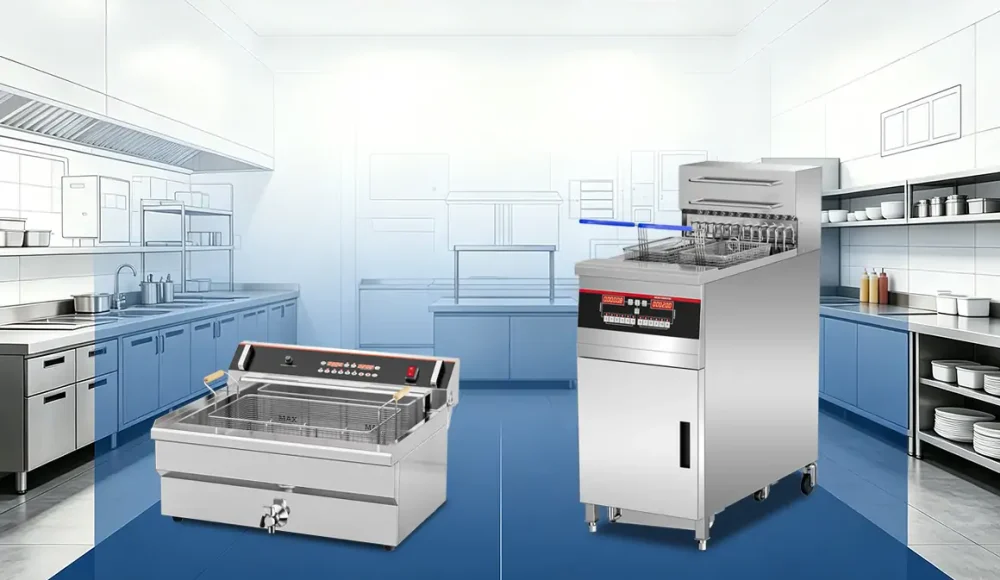
Choosing a commercial deep fryer isn’t really about finding the biggest tank or the highest wattage on the spec sheet anymore. The fryer that actually works for your business is the one that matches your daily order volume, your menu, your kitchen footprint, your staff, and how much you’re willing to spend on electricity and oil every month. Buy something oversized and you’re paying for capacity you’ll never use. Buy something undersized and your kitchen falls behind the moment a rush hits. From where we sit as a commercial fryer manufacturer, picking the right configuration is a balancing act between output, oil life, energy draw, and the return you get on the equipment over its working life — not a single number on a brochure.
Why Choosing the Right Commercial Deep Fryer Matters More Than Buying the Biggest One?
A lot of buyers walk in wanting the biggest tank and the highest kW rating they can afford, assuming bigger always wins. It doesn’t. A 60L tank sitting half-empty all day still needs the oil heated, filtered, and replaced on a schedule, so you’re burning money on volume you never touch. Meanwhile a fryer that’s too small forces your cooks to run extra batches during peak hours, which slows ticket times and wears the heating elements out faster from constant cycling.
What actually drives return on investment is the rhythm of your kitchen — how many orders you push out per hour, what’s actually on the menu, whether you’re frying continuously or in short bursts, how fast the oil recovers between batches, your oil cost per liter, how many staff are working the fryer station, and how much floor or counter space you can spare. Get those right and the equipment pays for itself. Get them wrong and even a “good” fryer becomes a bad purchase.
Choosing the Right Capacity and Tank Design for Different Restaurant Operations
Capacity and tank shape aren’t two separate decisions — they need to be made together, because the same 20L rating behaves completely differently in a standard tank versus a deep cold-zone tank.
For low-volume operations like small snack counters, coffee shops, or food trucks, a 10L to 16L tank with a standard shape is usually enough to keep up without wasting oil on unused volume. Once you move into burger shops, fried chicken counters, or fast-casual restaurants doing steady batch frying, 20L to 30L with a deep cold zone underneath the heating elements starts to make more sense — the cold zone catches crumbs and batter debris so they don’t burn and taint the oil, which extends oil life significantly. For high-volume operations like fried chicken chains, central kitchens, or multi-location restaurant groups, 40L to 60L tanks with reinforced cold zones or long-tank designs are built to handle continuous frying without the oil quality dropping mid-shift.
| Business Type | Typical Daily Volume | Suggested Capacity | Tank Design | Fits Best With |
|---|---|---|---|---|
| Snack shop / food truck | Low | 10L–13L | Standard tank | Compact countertop line (EF017 series) |
| Cafe / small restaurant | Low–Medium | 13L–16L | Standard tank | Compact countertop line (EF017 / EF011 series) |
| Burger shop / fast casual | Medium | 20L–30L | Deep cold zone | Mid-capacity line (EF004-A Series) |
| Fried chicken shop | Medium–High | 30L–40L | Deep cold zone | Mid-to-large line (EF001-SX Series) |
| Restaurant chain / central kitchen | High | 40L–60L | Deep cold zone or long tank | Large-capacity line (EF003-A4) |
A standard tank works fine for lighter items like fries or spring rolls, where debris is minimal. A deep cold zone matters most once you’re frying breaded or battered products — fried chicken, tempura, breaded fish — because that’s where crumbs accumulate fastest. A long tank, meanwhile, is built for kitchens frying longer items like whole fish or extended baskets side by side, where a square tank would waste space and oil.
Countertop or Floor-Standing Commercial Fryer? Match the Equipment to Your Kitchen Layout
Countertop fryers make sense when floor space is tight, ceiling clearance is limited, or the operation doesn’t need continuous heavy-duty output — think food trucks, small cafes, ghost kitchens, or a secondary fryer station in an already-crowded line. They sit on existing counters or prep tables, need less electrical infrastructure, and are easier to move or replace.
Floor-standing units are the better call once daily volume climbs, when a kitchen is running the fryer for hours without a break, or when the operation needs a larger oil reservoir that a countertop chassis simply can’t hold safely. They also tend to hold up better under continuous-duty cycles because the frame and components are built for sustained heat output rather than intermittent use.
| Situation | Countertop | Floor-Standing |
|---|---|---|
| Limited counter or floor space | Best fit | Not ideal |
| Continuous high-volume frying | Not ideal | Best fit |
| Secondary or backup fryer station | Best fit | Overkill |
| Central kitchen / commissary | Not ideal | Best fit |
| Food truck or mobile setup | Best fit | Not practical |
Don’t buy floor-standing just because it “looks more commercial” if your actual volume doesn’t need it — the extra footprint and higher price tag only pay off when you’re actually running it at capacity for most of the day.
Why Recovery Time Matters More Than Rated Power?
Buyers fixate on kW ratings, but the number that actually determines how fast your kitchen serves food is recovery time — how quickly the oil gets back up to frying temperature after you drop in a cold batch. A fryer rated at 6kW that recovers oil temperature within roughly 40 seconds will often push out more food per hour than a lower-power unit that takes over a minute to bounce back, because every batch is waiting on that recovery window before it can finish properly.
Lower-power units in the 2.5kW to 3kW range are usually fine for lighter, lower-volume frying — small snack items, occasional use, or menus where batches are small and spaced out. Once you’re running fried chicken, breaded proteins, or back-to-back batches during a lunch or dinner rush, 4.5kW to 7.5kW power ranges with faster recovery become the difference between keeping up with tickets and falling behind them. Undersized power doesn’t just slow service — it also means the oil sits below ideal frying temperature more often, which increases oil absorption into the food and shortens oil life.
The takeaway for buyers: don’t just ask “how many kW is this fryer” — ask “how fast does it recover between batches at my expected order volume.” That’s the number that actually shows up in your ticket times.
Mechanical Control or Smart Preset Menus? Understanding the Real Return on Investment
This isn’t a “which is better” question — it’s a “which fits your operation” question. Mechanical knob-controlled fryers are the right call for smaller operations with a lower upfront budget, a simple and stable menu, and staff who’ve been trained on the same equipment for a while. They’re straightforward to repair, cheaper to replace, and don’t require retraining every time you bring on new kitchen staff.
Smart fryers with preset menu buttons and digital temperature control start earning their higher price tag once you’re running a franchise, a multi-location chain, or any operation where consistency across locations matters more than upfront cost. Preset programs mean a new hire on day one can produce the same result as a five-year veteran, which matters enormously when staff turnover is high or when a brand needs every location to taste identical. The digital control also tends to hold temperature more precisely over long shifts, which protects oil life and food consistency in ways a manual dial can’t quite match.
For a single independent restaurant with a stable crew, mechanical control is usually the smarter spend. For a growing chain trying to standardize quality across locations and reduce training time, the smart control panel pays for itself through consistency alone, not just convenience.
How Manufacturers Evaluate ROI Instead of Product Price?
Buyers who only compare sticker prices are looking at the wrong number. What actually determines whether a fryer is a good investment is total cost of ownership: how long the unit lasts under your actual usage pattern, how much oil you go through and how often you have to change it, the labor time spent on cleaning and maintenance, how often it needs service or parts, and the electricity it draws over months and years of operation.
A cheaper fryer with a shorter element lifespan, poor temperature stability, or a tank design that lets oil degrade faster can easily cost more over three years than a pricier unit built with better cold-zone design and more accurate temperature control. This ties directly into decisions we’ve walked through in earlier posts on why stable temperature control protects both oil quality and equipment lifespan — the fryer’s control system and its long-term running cost are really the same conversation.
A Real Factory Recommendation from Shangbang
Before we recommend a configuration to any buyer, we ask a handful of questions first: what’s actually on the menu, what hours the kitchen runs, whether the main product is something delicate like fries or something heavier like fried chicken, whether there’s a filtration system in place, roughly how many portions go out per day, what voltage is available on site, and how much physical space the kitchen has to work with. We’re not trying to sell the most expensive unit on the floor — we’re trying to match the fryer to how the kitchen actually operates, because that’s what determines whether the buyer is happy with the purchase a year later.
Related Engineering Topics Worth Exploring Before Making a Purchase
A lot of buyers who work through capacity and power end up asking related questions too — why the cold zone design matters so much for oil life, why stable temperature control affects how long the heating elements last, and why a proper filtration routine can cut oil costs more than any other single factor. We’ve gone deep on drain valve design and cleaning routines in a previous piece on keeping oil clean and maintenance simple, and it’s worth a look if any of these questions are still open for you — understanding these engineering details is usually what separates buyers who are happy with their fryer three years in from the ones who regret the purchase within the first six months.
How Global Buyers Actually Choose a Commercial Deep Fryer?
When distributors, restaurant chains, and OEM brands evaluate commercial fryers, they rarely start with a spec sheet in isolation. They compare expected daily output against recovery time, weigh oil consumption against maintenance frequency, and factor in available kitchen space alongside future expansion plans. Treating fryer selection as a business investment decision — rather than a single product purchase — is what tends to reduce long-term operating costs and keep quality consistent across multiple locations.
Buyer Decision Table: Match Your Business to a Configuration
| Business Type | Capacity | Tank Type | Power | Control | Best Format |
|---|---|---|---|---|---|
| Food truck | 10L | Standard | 2.5–3kW | Mechanical | Countertop |
| Cafe | 13L | Standard | 3–3.5kW | Mechanical | Countertop |
| Burger shop | 20L | Deep cold zone | 4.5kW | Mechanical | Countertop |
| Fried chicken shop | 30L | Deep cold zone | 6kW | Digital / preset | Countertop or floor-standing |
| Restaurant chain | 40L | Deep cold zone | 7.5kW | Smart preset menu | Floor-standing |
| Central kitchen | 60L | Deep cold zone / long tank | High power, multi-element | Smart / programmable | Floor-standing |
FAQs
Is a bigger commercial deep fryer always the better investment?
No. A larger tank that isn’t matched to your daily volume wastes oil, electricity, and counter or floor space. The right capacity is the one that matches your actual order flow, not the largest number available.
How do I know if I need a countertop or floor-standing fryer?
It comes down to kitchen space and how continuously you fry. Limited space or lighter, intermittent use favors countertop; high-volume, all-day frying favors floor-standing units built for continuous duty.
Why does recovery time matter more than the kW rating?
The kW rating tells you potential heat output, but recovery time tells you how fast the oil actually gets back to frying temperature between batches — which is what really determines how many orders you can serve per hour.
Should I choose mechanical controls or a smart preset menu system?
Mechanical controls suit smaller operations with a stable menu and trained staff who want a lower upfront cost. Smart preset systems suit chains and franchises that need consistent results across locations and faster staff training.
What’s the real difference between a standard tank and a deep cold zone?
A standard tank works fine for lighter items with minimal debris. A deep cold zone traps crumbs and batter below the heating elements, which keeps them from burning into the oil — this matters most for breaded or battered foods like fried chicken.