

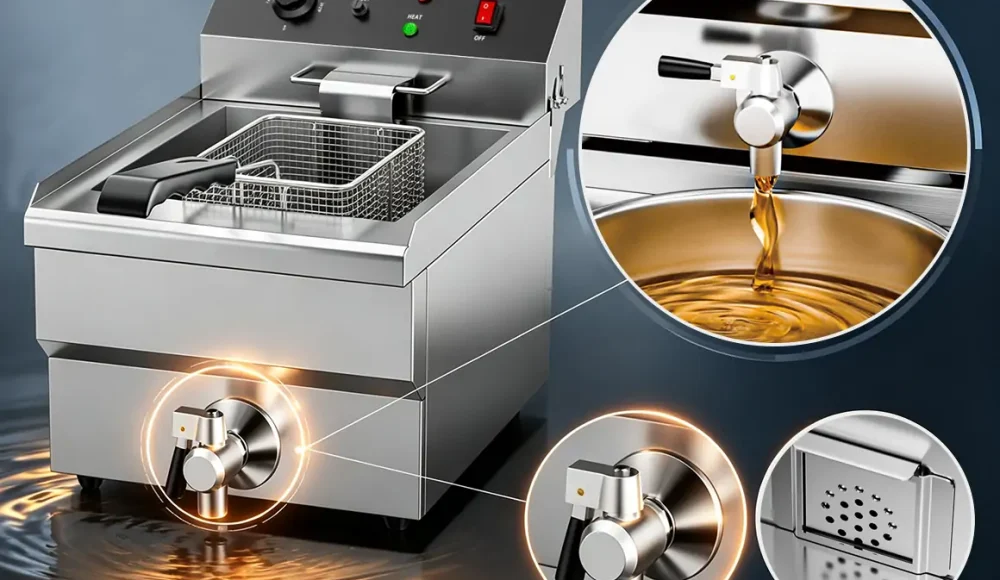
Why does the drain valve matter so much on a commercial deep fryer?
Ask any kitchen manager what the most annoying part failure is on a fryer, and there’s a good chance they’ll say the drain valve. It looks like a small, forgettable part on a commercial deep fryer with drain valve manufacturer line-up, but it’s actually one of the hardest-working components in the whole machine. Every time oil gets filtered, changed, or the tank gets cleaned, that valve gets opened and closed. In a busy kitchen running 12 to 16 hours a day, that’s not an occasional task, it’s a routine that repeats itself hundreds of times a year, with hot oil, food particles, and cleaning chemicals passing through the same small mechanism over and over again.
That repetition is exactly why valve lifespan isn’t really about brand names or shiny finishes. It comes down to whether the internal structure was built to match the real workload of a restaurant deep fryer running at full tilt, day after day. At Shangbang, this is something we’ve spent years testing rather than guessing at. Since 2015, we’ve evaluated more than 40 different drain valve structures across our fryer lines. What came out of that process wasn’t a single “best” valve on paper, it was a heavy-duty 304 stainless steel ball valve that consistently showed lower failure rates and longer service life once it left the test bench and went into real commercial kitchens.
Two Different Oil Draining Designs Used in Commercial Fryers
Not every fryer in our lineup uses the same draining method, and that’s intentional rather than inconsistent. Smaller countertop units, like our EF007 series and EF017 series, both sitting around the 10L capacity range, use a lift-out oil tank design instead. The operator simply lifts the tank and pours the oil out, which works well for lower-volume kitchens that don’t need to filter oil constantly throughout the day.
Larger and higher-throughput models take a different approach. Floor-standing fryers, large-capacity units, and fryers with built-in filtration systems, including our EF011 and EF021-B1 EF021-B2, along with heavier-duty configurations like the EF001-SX series, rely on a dedicated drain valve instead. This setup makes far more sense once oil volume climbs, since pouring a full tank by hand becomes impractical and honestly a bit dangerous with hot oil involved. If you’re comparing a commercial countertop deep fryer against a floor model for a new location, the draining mechanism is one of the first things worth checking, because it changes your daily workflow more than people expect.
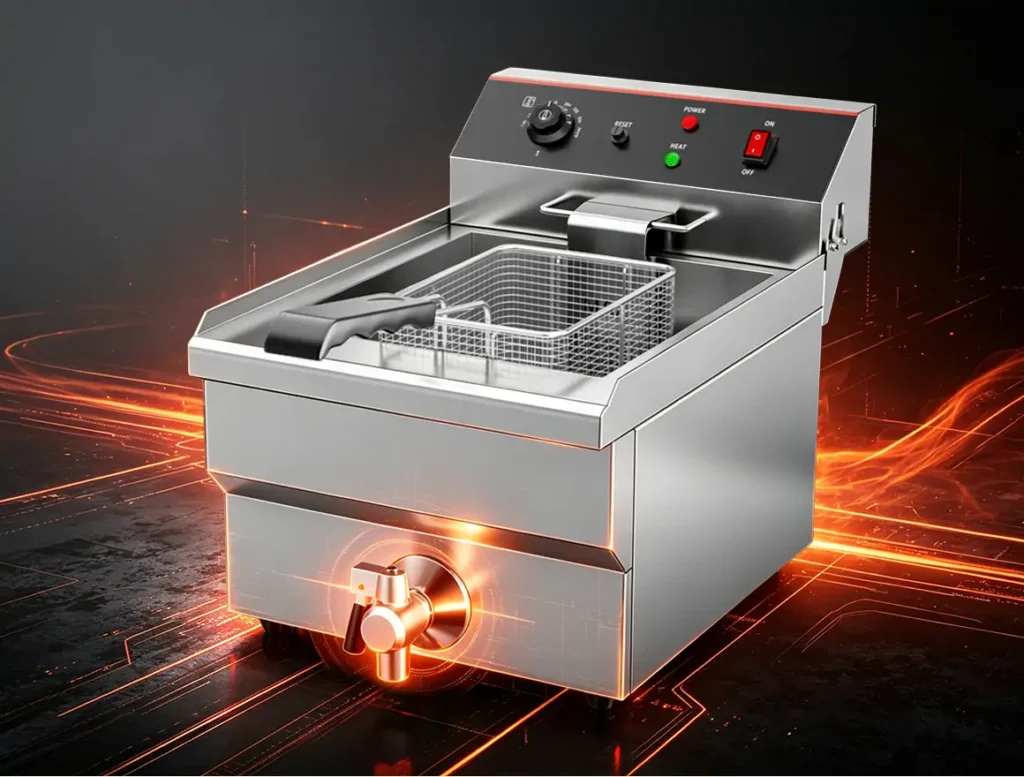
Why Commercial Fryers Need Heavy-Duty Drain Valves?
A drain valve on a commercial unit isn’t dealing with mild conditions. It’s regularly exposed to oil sitting between 180°C and 200°C, along with food debris, breading crumbs, and sediment that settles at the bottom of the tank. Every open-close cycle puts pressure on the seal, and every cycle wears the valve ball just a tiny bit more. This is exactly why a standard brass valve, the kind you’d find in a residential appliance, doesn’t hold up in this environment. Cheaper valve assemblies tend to warp seals faster under thermal cycling and lose their tight seal within months rather than years.
That’s the reasoning behind standardizing on 304 stainless steel ball valves across our commercial deep fryer wholesale production. Stainless steel handles thermal expansion and contraction far better than brass, resists pitting from oil residue, and the ball-valve mechanism itself gives a cleaner, more complete shut-off than older gate-style valves. For anyone sourcing from a commercial electric fryer factory, asking specifically what valve material and mechanism is used should be near the top of the supplier questionnaire, right alongside heating element specs.
The Most Common Drain Valve Problems
Most valve complaints we hear from operators and distributors fall into a fairly predictable set of patterns:
| Problem | Typical Cause | Fix |
|---|---|---|
| Oil leakage from the valve | Seal wear from heat cycling | Replace the seal or full valve assembly |
| Valve becomes hard to turn | Carbon and residue buildup | Clean the valve internals thoroughly |
| Valve gets blocked | Food debris trapped inside | Flush the valve with hot water |
| Slow or partial drainage | Oil residue coating the passage | Regular cleaning after each filtration cycle |
| Handle cracks or snaps | Excessive force used to close it | Replace the handle, avoid over-tightening |
| Valve won’t fully close | Ball or seat wear from long-term use | Replace worn components before full failure |
Oil leakage tends to be the one that generates the most support calls, so it’s worth digging into why it happens.
Why Oil Leakage Happens After Long-Term Use?
Here’s the thing most people get wrong: valve leakage almost never means the part was defective out of the box. It’s a wear pattern tied directly to usage frequency and heat exposure. Every open-close action puts mechanical stress on the seal, and the constant swing between hot oil temperatures and room temperature during cleaning causes repeated expansion and contraction. Seals harden and lose flexibility over time, and the ball surface itself picks up microscopic wear from friction. None of these are manufacturing flaws, they’re simply wear items, the same way brake pads or gaskets are expected to need replacement eventually in any mechanical system.
How Heavy Usage Shortens Drain Valve Lifespan?
The math on this is pretty straightforward once you break it down. A lower-volume restaurant might only need an oil change every two to three days, with the valve opened once daily for filtering or draining. A high-volume fried chicken shop running 12 hours a day is a completely different story. These operations often change oil once or even twice daily, which pushes valve cycles well past 700, sometimes over 1,000, uses in a single year. That’s not a small difference, it’s the reason a large deep fryer running in a high-turnover kitchen needs a fundamentally more robust valve than one sitting in a low-traffic cafe.
Why We Standardized on Heavy-Duty 304 Stainless Steel Ball Valves
Going back to that testing process, the 40-plus valve structures we evaluated since 2015 weren’t just compared on paper specs. We tracked actual field return rates, warranty claims, and direct feedback from OEM partners running these fryers in commercial settings. What consistently rose to the top wasn’t the cheapest option or even the most complex design, it was the 304 stainless steel ball valve, largely because its failure curve was flatter and more predictable than alternatives. When a double tank deep fryer manufacturer builds a unit meant to run in high-heat commercial kitchens for years, that predictability matters more than shaving a few cents off the bill of materials.
How We Help OEM and Wholesale Buyers Reduce After-Sales Problems?
For wholesalers, brand owners, and clients running ODM OEM deep fryer programs, valve issues aren’t just a maintenance headache, they directly affect after-sales cost and customer satisfaction downstream. That’s why we typically include a stock of spare valves alongside bulk orders, along with clear maintenance documentation and, where needed, short video walkthroughs showing seal replacement and cleaning steps. It sounds like a small gesture, but it measurably reduces after-sales tickets for our custom deep fryer clients, and a lower after-sales rate is honestly what keeps a wholesale relationship going for years instead of one order.
Quality on our end keeps improving too, not because of pressure to cut corners, but because our whole positioning has always leaned toward the quality end of the market rather than racing to the bottom on price. A low after-sales burden is, frankly, the difference between a one-time buyer and a long-term partner.
Daily Maintenance Tips That Extend Drain Valve Life
A few habits go a long way toward keeping a drain valve functional for years instead of months:
Let the oil cool slightly before opening the valve rather than draining it at peak temperature, since sudden thermal shock accelerates seal wear. Flush the valve passage with hot water after every oil change, not just an occasional deep clean. Avoid forcing the handle if it feels stiff, since applying extra torque is exactly how handles crack or internal threads strip. Check the seal periodically for hardening or cracking rather than waiting for a visible leak to show up. None of this takes more than a couple of minutes per shift, but skipped consistently, it’s the single biggest reason valves fail early.
Never Drain Solid Shortening Through the Valve
This one comes up constantly, and it’s worth calling out directly: draining shortening while it’s still solid or semi-solid is one of the fastest ways to damage a valve. As shortening cools, it firms up and can jam the ball mechanism or get wedged against the seal, forcing the valve to work against resistance it wasn’t designed for. The better approach is to drain any liquid oil first, then deal with solid shortening separately once it’s warmed enough to flow, rather than forcing the valve to push through a partially solid mass.
Clean the Drain Valve Every Time You Clean the Fryer
A surprisingly common gap in kitchen routines is thorough tank cleaning paired with a completely ignored drain valve. Carbon and oil residue build up inside the valve passage just as much as they do in the tank itself, and skipping it leads to slow drainage and eventually leaks. Running hot water and a food-safe cleaner through the valve every time the tank gets cleaned keeps carbon buildup from accumulating in the first place. If you’re trying to stretch equipment life further, this pairs naturally with something we’ve covered before on keeping heating elements protected through regular fryer cleaning, since the same buildup that clogs a valve is often the same residue that shortens heating element life over time.
How Drain Valve Maintenance Connects With Oil Filtration?
This ties directly into a topic we’ve discussed previously around integrated oil filtration systems and portable oil filter machines for commercial fryers. Cleaner oil circulating through the tank means less sediment settling near the valve opening, which translates into less carbon buildup and fewer blockages over time. Whether a kitchen uses a built-in filtration setup or a standalone unit rolled between stations, the end result is the same: a fryer oil filtration system doesn’t just extend oil life and protect heating elements, it takes real pressure off the drain valve too, since it’s filtering out much of the debris that would otherwise pass through it daily.
What Experienced B2B Buyers Always Ask Before Purchasing?
Buyers who’ve been burned by cheap fryers before tend to ask sharper questions upfront.
Is the valve genuinely 304 stainless steel, or just labeled that way?
How long does it typically last under daily commercial use before needing a seal replacement?
Are spare valves or repair kits included with bulk or OEM orders?
Is there documentation or video support for replacement procedures?
What’s the actual stock availability if a valve needs replacing mid-contract?
These questions come up often enough in our conversations with wholesalers and distributors that we’ve built our production and after-sales process specifically around answering them clearly, rather than leaving buyers to figure it out after the equipment ships.
FAQs
How often should a commercial fryer’s drain valve be replaced?
It depends heavily on usage frequency, but under heavy daily commercial use, valve seals typically need attention within one to two years, while the valve body itself can often last considerably longer if cleaned regularly.
Why is my fryer’s drain valve leaking even though it’s not that old?
Leakage is almost always tied to cycle count and heat exposure rather than age alone, so a heavily used fryer can develop leaks faster than a lightly used one of the same age.
Can I just replace the seal instead of the entire valve?
In most cases, yes. If the ball and body are still in good shape and the issue is limited to leakage, a seal replacement alone often resolves the problem.
Should I drain shortening while it’s still solid?
No. Solid or semi-solid shortening should be allowed to warm and become liquid before draining, since forcing it through the valve while solid risks jamming the mechanism or damaging the seal.
Why do OEM and wholesale buyers often request spare valves with their orders?
Because a drain valve is a wear part by nature, keeping spares on hand lets operators do a quick swap rather than waiting on a shipment, which noticeably reduces after-sales complaints and downtime.