

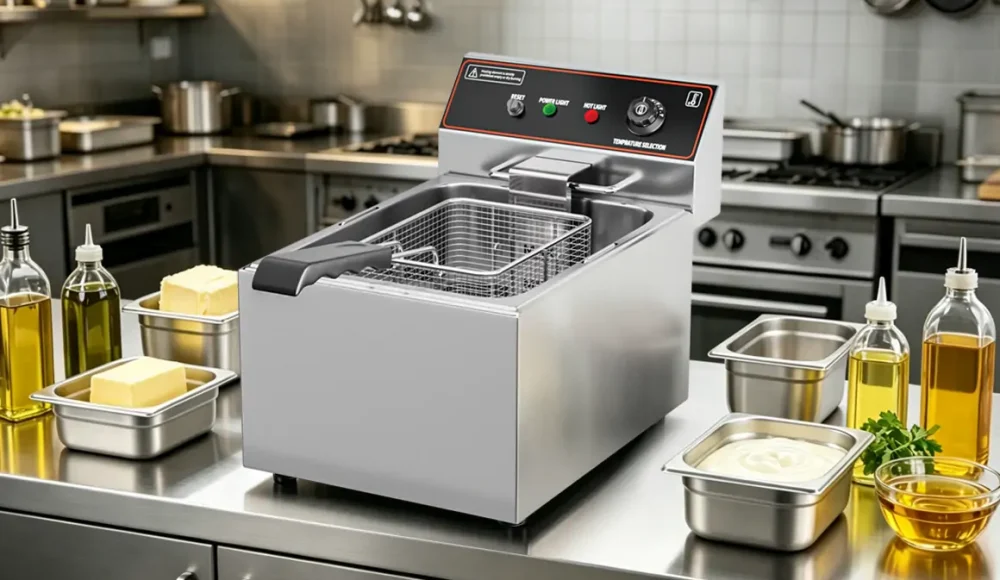
Commercial kitchens rarely fail because of recipes. More often, performance issues start from two decisions:
oil selection and frying equipment structure.
As a commercial deep fryer manufacturer, commercial fryer manufacturer China, and OEM commercial deep fryer supplier serving restaurant chains, distributors, wholesalers, and foodservice brands worldwide, Shangbang regularly helps buyers evaluate both frying oils and fryer system performance. Many operators focus entirely on oil cost while overlooking fryer engineering, cold-zone structure, and temperature recovery capability. Those factors ultimately determine oil lifespan, food consistency, maintenance costs, and long-term profitability.
This guide is built from real production feedback across restaurant chains using industrial frying systems, including cold-zone fryer configurations used in high-volume kitchens.
Can you use olive oil in a deep fryer?
Olive oil typically has a smoke point around 160°C–190°C (320°F–374°F) depending on refinement level.
Commercial deep frying usually operates at:
French fries: 175°C–180°C
Fried chicken: 170°C–185°C
Continuous fast food frying: 175°C–190°C cycles
At this range, extra virgin olive oil approaches or exceeds its thermal stability threshold.
Once oil exceeds its smoke point:
Free fatty acids increase rapidly
Polymerization accelerates (oil darkening)
Flavor compounds break down
Oil life shortens significantly under batch frying cycles
In industrial kitchen environments (fast food chains, high-output fry stations), this leads to high oil turnover cost and unstable flavor consistency, making olive oil unsuitable for most commercial fryer systems.
Can you use beef tallow in a deep fryer?
Beef tallow has a high smoke point range of approximately 200°C–250°C (392°F–482°F) depending on purity and rendering quality.
This places it above standard commercial frying temperatures:
Most deep frying: 170°C–185°C
High-temperature searing fry systems: 185°C–190°C
Because of this margin, beef tallow maintains:
Structural stability under repeated heating cycles
Lower oxidation rate compared to unsaturated vegetable oils
Better crisping performance due to saturated fat composition
In continuous frying systems, tallow retains stability longer before reaching degradation thresholds.
However, in long-hour commercial kitchens, thermal stability is only part of the equation. Fat crystallization behavior during cooling cycles can affect filtration systems and oil circulation pipelines in fryer tanks.
Can you use lard in a deep fryer?
Lard typically has a smoke point range of 190°C–220°C (374°F–428°F) depending on refinement and free-fatty-acid content.
Commercial deep frying zones usually operate:
Standard frying: 170°C–185°C
High-output batch frying: 180°C–190°C
Within this range, lard performs well, but its degradation curve depends heavily on:
impurity levels
moisture content
filtration frequency
In continuous commercial fryer systems, lard tends to break down faster than refined vegetable oils because its oxidation stability is lower under repeated heating and cooling cycles.
This makes it more suitable for:
medium-scale restaurants
traditional cuisine frying systems
controlled batch frying environments
Can you use vegetable oil in a deep fryer?
Refined vegetable oils (soybean, sunflower, corn blends) typically operate with a smoke point range of 200°C–230°C (392°F–446°F).
This range comfortably covers commercial frying temperatures:
Standard fryer operating zone: 170°C–185°C
Overheat safety threshold: ~190°C+
Vegetable oil performs well because:
It remains stable within fryer operating bands
It resists flavor contamination in multi-product fry lines
It maintains predictable viscosity during continuous heating cycles
In industrial fryer systems, vegetable oil is often used as a baseline test medium because it provides consistent thermal response curves across equipment validation tests.From the perspective of an electric deep fryer manufacturer China, refined vegetable oil remains the most commonly tested frying medium during commercial fryer performance validation because it delivers predictable thermal behavior across different operating environments.
Can you use canola oil in a deep fryer?
Canola oil has a smoke point around 200°C–230°C (392°F–446°F), placing it in the optimal range for commercial deep frying systems.
Typical fryer operation:
Frying zone: 170°C–185°C
Recovery cycles: up to 190°C peak fluctuation
Canola oil performs strongly in this range due to:
Low saturated fat content (slower polymer buildup)
High thermal tolerance before oxidation onset
Stable viscosity under repeated batch cycles
In franchise-scale operations, canola oil is often selected because it aligns with long oil life + predictable frying output across multiple locations using standardized fryer equipment.For restaurant groups evaluating equipment from a commercial electric deep fryer manufacturer, canola oil is often selected during pilot testing because its frying stability allows accurate comparison between different fryer designs and heating systems.
Can you use avocado oil in a deep fryer?
Avocado oil has one of the highest smoke points in commercial food oils:
~250°C–270°C (482°F–518°F).
This exceeds normal deep frying operating ranges by a wide margin:
Commercial frying zone: 170°C–185°C
Avocado oil stability ceiling: 250°C+
From a thermal engineering perspective, this means:
Very slow oxidation onset under fryer conditions
Extremely stable molecular structure during heating cycles
However, in industrial kitchens, oil cost per liter dominates decision-making. Because fryer systems operate in continuous high-volume cycles, avocado oil becomes economically inefficient despite its thermal advantages.
It is typically reserved for:
premium small-batch frying
boutique restaurant concepts
low-throughput controlled frying systems
Can you deep fry without a deep fryer?
Deep frying without a dedicated fryer introduces uncontrolled thermal behavior.
Typical open-pot frying conditions:
Heat fluctuation range: ±15°C to ±30°C
No automatic recovery system
No oil filtration loop
Commercial fryer systems maintain:
Controlled thermostat range: ±1°C to ±2°C
Rapid heat recovery after batch loading
Sediment separation (cold-zone design in industrial units)
Without control systems, oil degradation accelerates because:
localized overheating exceeds smoke point zones
carbon particles remain suspended longer
oxidation reaction rate increases under unstable thermal cycling
This is why commercial kitchens standardize fryer equipment rather than relying on manual frying methods.
Can you use Crisco in a deep fryer?
Crisco-type shortening typically has a smoke point around 190°C–230°C (374°F–446°F) depending on formulation.
This aligns with deep frying operating conditions:
Standard frying: 170°C–185°C
High-temperature batch frying: up to ~190°C
Its behavior differs from liquid oils because:
It transitions phase (solid → liquid) before frying
Maintains structural stability during frying cycles
Exhibits slower oxidation compared to some vegetable oils
In commercial use, it performs well in controlled systems such as bakery fry lines where fryer temperature consistency is tightly regulated.
Why Temperature Control Matters More Than Oil Type in Commercial Deep Fryers?
Experienced buyers sourcing equipment from a commercial kitchen fryer manufacturer understand that oil quality alone cannot compensate for poor temperature control. A fryer that consistently overshoots target temperatures can shorten oil life regardless of whether vegetable oil, canola oil, beef tallow, or shortening is used.Across all oil categories, one engineering truth dominates commercial frying systems:
Oil lifespan is not defined only by smoke point. It is defined by time spent near degradation temperature thresholds.
In real kitchen operations:
Frequent batch loading causes temporary temperature drops
Recovery heating creates micro-overshoot zones
Food moisture triggers localized thermal spikes
This is where commercial fryer structure becomes critical:
cold-zone separation reduces carbon burn
stable heating tubes reduce thermal spikes
controlled thermostats prevent continuous overheat cycles
This is also why equipment design (not just oil selection) determines profitability in commercial frying operations.
Oil Choice vs Commercial Fryer Design
Most buyers assume oil determines frying quality.
In industrial kitchen engineering, oil only controls part of the system.
The fryer determines:
heat distribution consistency
oil oxidation speed
filtration efficiency
food texture repeatability
batch stability across long operation hours
This is why professional buyers evaluate fryer structure before oil type.
Why Cold-Zone Deep Fryers Reduce Oil Costs in Commercial Kitchens?
One of the most important engineering features developed by leading commercial frying equipment manufacturers is the cold-zone frying system. This design is widely used in premium commercial electric fryers because it helps extend oil life and reduce operating costs.
In a cold-zone fryer, food debris sinks below the heating area and stays away from active thermal zones.
This reduces:
oil carbonization rate
burnt residue accumulation
oil replacement frequency
Buyers comparing suppliers often discover that two fryers using the same oil can produce completely different operating costs. This is one reason distributors and restaurant chains frequently evaluate specialized stainless steel deep fryer manufacturers, countertop deep fryer manufacturers, and industrial deep fryer manufacturers before making purchasing decisions.Commercial buyers looking for higher oil efficiency often compare fryer systems in this category:
https://www.shangbangcee.com/product-tag/cold-zone-deep-fat-fryer/
Why Oil Behavior Changes Across Fryer Types?
Even the same oil performs differently depending on equipment structure.This performance difference is one reason why buyers searching for a deep fryer supplier China or commercial deep fryer factory often request real-world oil consumption data before finalizing equipment specifications.
For example:
vegetable oil in a standard fryer → faster degradation
vegetable oil in a cold-zone fryer → extended usable cycle
This difference directly impacts:
operating cost per batch
flavor consistency across franchise outlets
maintenance downtime frequency
OEM Commercial Deep Fryer Manufacturing Insight from Shangbang
As a deep fryer manufacturer China and private label deep fryer manufacturer, Shangbang develops frying equipment for distributors, restaurant chains, foodservice brands, and OEM customers seeking long-term operational consistency.
Custom projects frequently involve voltage adaptation, basket customization, branding, packaging, control system modification, and stainless steel upgrades. These requirements are common among buyers looking for a custom commercial fryer manufacturer capable of supporting OEM and ODM programs.
Manufacturing focus includes:
stainless steel thermal stability design
industrial heating tube configuration
oil tank geometry optimization
cold-zone residue separation structure
temperature control calibration for ±1–2°C consistency
These parameters are tested under continuous frying simulation conditions used by restaurant chains and OEM buyers.
Oil Selection Alone Does Not Determine Profitability
Restaurant operators evaluating proposals from multiple commercial electric fryer suppliers often compare equipment pricing first. However, long-term profitability is more closely tied to oil consumption, maintenance frequency, heating efficiency, and production consistency than initial purchase cost alone.A key insight often overlooked in procurement decisions:
Two kitchens using identical oil types can still have completely different operating costs.
The difference comes from:
fryer heat recovery speed
oil filtration cycle efficiency
residue burn rate
temperature fluctuation control
This is directly connected to system design, not ingredient choice.
This concept is further expanded in this guide:
https://www.shangbangcee.com/commercial-electric-deep-fryer-for-restaurant/
Choosing the Right Commercial Fryer Manufacturer Matters as Much as Choosing the Right Oil
Selecting the correct frying oil can improve food quality and reduce operating costs. Selecting the right fryer manufacturer can influence every batch produced for years.
When evaluating a commercial fryer supplier, buyers should review:
Temperature recovery performance
Cold-zone design
Oil filtration compatibility
Stainless steel construction
OEM and private label capabilities
Spare parts support
Production capacity
Export certifications
As a commercial deep fryer manufacturer with more than 20,000㎡ production facilities and extensive OEM experience, Shangbang supports distributors, wholesalers, restaurant chains, and foodservice equipment importers worldwide with customized frying solutions.