

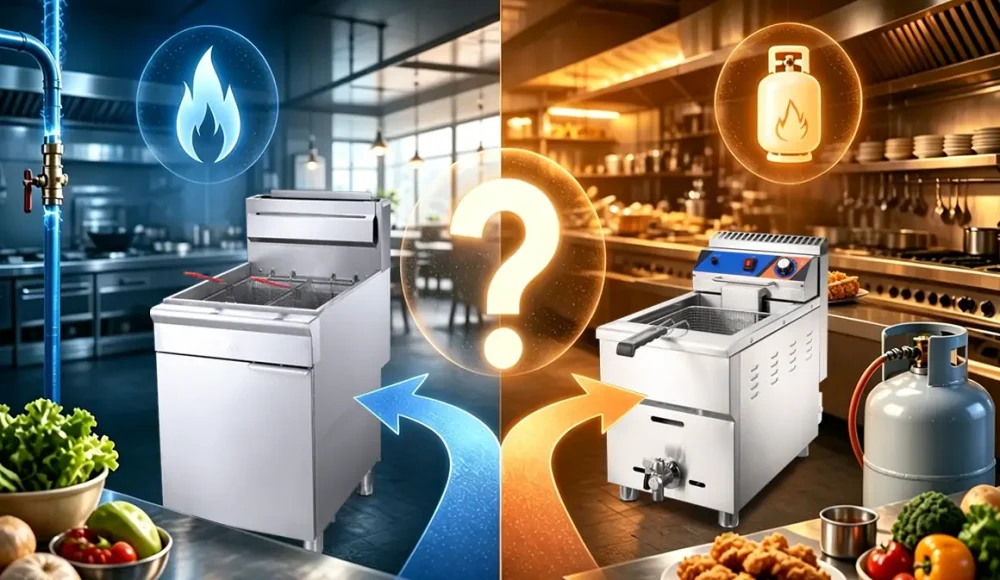
Choosing between a commercial gas fryer and an electric fryer is not simply a matter of asking which one heats faster or costs less to operate. For a restaurant, the better fryer depends on how many hours the kitchen operates, how much food is fried during peak periods, what type of gas or electrical infrastructure is already available, how much kitchen space is available, and how the equipment will be maintained over several years.
For a small commercial kitchen without a gas connection, an electric fryer can be a practical choice because installation is generally straightforward when the available electrical supply matches the fryer’s requirements. For a busy restaurant, fried chicken shop, fast-food operation, or central kitchen that already has suitable gas infrastructure, a commercial gas fryer can make more sense when continuous high-volume frying is a priority.
There is also an important difference between choosing equipment for your own restaurant and sourcing equipment as a distributor, wholesaler, or private-label brand. A restaurant operator may focus on daily cooking performance and installation. A B2B buyer also needs to think about spare parts, gas configuration, certifications, consistency between production batches, after-sales service, and whether the manufacturer can support future orders.
That is where the manufacturer’s experience becomes important.
Shangbang has been developing and manufacturing commercial kitchen equipment since 2015, with commercial fryers as one of its main product categories. Over years of product development and production, the company has worked with different fryer structures, capacities, heating systems, and configurations for commercial foodservice applications. This experience gives us a practical perspective on where gas fryers make sense, where electric fryers are more suitable, and what B2B buyers should examine before placing a bulk order.
Is a Gas Fryer or Electric Fryer Better for a Commercial Kitchen?
Neither technology is universally better. A gas fryer is generally a strong choice for high-volume kitchens that already have suitable gas infrastructure and require sustained frying performance, while an electric fryer can be more convenient where gas is unavailable or where simpler installation and electrical control are more important.
The real decision starts with the kitchen rather than the fryer.
A restaurant operating twelve to sixteen hours every day has very different requirements from a small snack shop that fries food for only a few hours. A fried chicken restaurant may continuously load frozen products into the fryer during lunch and dinner peaks, while a small café may use its fryer intermittently. A central kitchen supplying several outlets may prioritize production capacity, while a compact restaurant may care more about footprint and installation flexibility.
This is why commercial fryer selection should consider the complete operating environment rather than comparing one specification at a time.
For B2B buyers, the same principle applies at an even larger scale. A commercial fryer manufacturer may offer several gas and electric configurations because different markets have different energy infrastructure. A distributor selling into a region with widespread natural gas availability may need a different product mix from a distributor serving customers that commonly use LPG.
The right fryer is the one that fits the customer’s actual working conditions.
How Does a Commercial Gas Fryer Compare With an Electric Fryer During Busy Service?
During a busy service period, the most important issue is not how quickly an empty fryer reaches its set temperature. What matters more is how the fryer behaves after cold or frozen food enters the oil and how consistently it can recover during repeated frying cycles.
When food is dropped into hot oil, the oil temperature naturally falls. The fryer then needs to transfer enough heat back into the oil to return to the target cooking temperature. If a restaurant is continuously frying chicken, French fries, fish, or other frozen products, this process happens again and again throughout the day.
A well-designed gas fryer can be particularly attractive in this environment because the burner system supplies heat continuously beneath the cooking tank. This makes commercial gas fryers a common choice for kitchens where sustained production is more important than compact installation.
Electric heating has its own advantages. Heating elements can provide direct heat transfer inside or around the oil tank, and electric fryer designs can offer precise temperature control and relatively straightforward operation. For restaurants that already have sufficient electrical capacity, an electric deep fryer can be easier to integrate into a kitchen without installing a gas line.
The important point is that heat recovery should be considered together with the fryer’s overall design. Burner output, heating area, oil volume, tank geometry, thermostat or control system, insulation, and the way food is loaded all influence actual frying performance.
A high-power specification on a product sheet does not automatically mean a fryer will perform better in a real restaurant.
When Does a Restaurant Usually Choose a Natural Gas Fryer?
A natural gas fryer is often a strong option when a commercial kitchen already has a stable natural gas supply and the fryer will be used heavily throughout the day.
Natural gas is commonly considered during equipment planning for restaurants, hotels, food courts, institutional kitchens, and other commercial foodservice operations where gas infrastructure is already available. For these kitchens, installing a gas fryer can fit naturally into the existing cooking system.
The decision also depends on local regulations and installation requirements. Gas equipment needs an appropriate gas connection, ventilation, and exhaust system, and the exact gas pressure and configuration need to match the requirements of the destination market.
For an importer or distributor, this becomes especially important. A fryer manufactured for one gas specification should not simply be assumed to work with another gas supply. Natural gas configurations and LPG configurations can require different components and settings.
This is one reason experienced commercial fryer manufacturers ask B2B customers about their target market before confirming production details.
A restaurant buyer should be asking the same questions before purchasing.
When Is an LPG Gas Fryer a Better Choice?
An LPG gas fryer can be a practical solution for commercial kitchens where LPG is the available fuel source or where the local infrastructure makes LPG more convenient than natural gas.
LPG is widely used in commercial kitchens in markets where a piped natural gas network is not readily available. It can therefore be particularly relevant for restaurants, food businesses, and commercial kitchens operating in areas where bottled or centralized LPG supply is common.
However, LPG should not simply be treated as a different name for natural gas.
The burner configuration, gas pressure, regulator, and other components need to be appropriate for the intended fuel. A responsible gas fryer manufacturer should confirm the gas type and relevant technical requirements before production rather than expecting customers to adapt the equipment after delivery.
For wholesalers and distributors, this is an important purchasing detail. When requesting a quotation for a commercial gas fryer, clearly specifying whether the destination market requires natural gas or LPG helps avoid configuration mistakes later.
What About Installation: Gas Fryer or Electric Fryer?
Installation can completely change the answer.
If a restaurant already has a suitable gas line and commercial ventilation system, adding a gas fryer may be straightforward. If the building does not have gas infrastructure, however, introducing gas equipment can require additional installation work, approvals, ventilation considerations, and professional servicing.
Electric fryers can be easier to install in locations where the required electrical supply is already available. The challenge is making sure the building’s electrical capacity is sufficient for the selected fryer.
This is particularly important for high-power commercial electric fryers. A restaurant cannot simply look at the fryer’s rated power and assume that any available outlet will be sufficient. Voltage, frequency, phase configuration, circuit capacity, and local electrical requirements all need to be checked.
For international B2B buyers, this becomes even more important because commercial kitchen equipment is sold into markets with different electrical and gas standards.
That is why product customization should begin with technical requirements rather than branding.
Why High-Volume Restaurants Often Prefer Commercial Gas Fryers
A high-volume restaurant does not use a fryer like a household appliance.
During a busy shift, staff may load food continuously, filter oil, drain oil, clean the cooking tank, and prepare the equipment for another service period. The fryer may remain in operation for twelve hours or more.
Under these conditions, durability and serviceability become just as important as cooking performance.
A commercial gas fryer can be particularly suitable for this type of environment when the restaurant has the appropriate gas and ventilation infrastructure. The freestanding format also allows manufacturers to build larger oil capacities and higher-output heating systems without being restricted to a small countertop footprint.
This is the thinking behind Shangbang’s GF3, GF4, and GF5 freestanding gas fryer range.
Rather than making one large fryer and simply changing the appearance, different models are intended to cover different levels of commercial production. This gives distributors and restaurant equipment buyers more flexibility when matching fryer capacity to customer requirements.
For smaller commercial kitchens where floor space is limited, a countertop gas fryer can offer another option. Shangbang’s GF-0030 and GF-0031 are designed around this requirement, providing gas-powered frying in a more compact countertop format.
The distinction matters because a restaurant does not always need the biggest fryer available. It needs the fryer that fits its production volume, kitchen layout, and available infrastructure.
Shangbang Freestanding Gas Fryers: GF3, GF4 and GF5
For customers looking for a freestanding deep fryer for a high-volume commercial kitchen, the GF3, GF4, and GF5 series provide three options within Shangbang’s gas fryer range.
The main idea behind the series is simple: commercial kitchens have different production requirements.
A busy fried chicken restaurant may need a larger oil capacity and sustained production throughout long service periods. Another restaurant may have high demand but limited staff and therefore benefit from equipment that makes draining, cleaning, and routine operation straightforward.
This is why fryer selection should not stop at the words “gas fryer.”
A B2B buyer should examine the complete system: oil capacity, tank construction, heating output, burner configuration, temperature control, drainage design, dimensions, gas type, available certifications, spare parts, and the manufacturer’s ability to maintain consistent production.
GF3 for Commercial Restaurant Applications
The GF3 is positioned as a freestanding gas fryer for commercial foodservice environments where floor-standing equipment and higher production capacity are required.
Its format makes it suitable for kitchens that need a dedicated frying station rather than a compact countertop appliance. This type of equipment can be particularly relevant for restaurants where frying is a major part of the menu rather than an occasional cooking task.
For distributors, the value of a freestanding model is also related to market coverage. Many restaurant operators specifically look for floor-standing commercial frying equipment because they expect their fryer to operate as part of a larger production line.
GF4 for Higher-Output Commercial Frying
GF4 is designed for buyers looking for another level of production within the freestanding gas fryer range.
When a restaurant’s frying volume increases, simply asking whether the fryer can reach the target temperature is no longer enough. Oil capacity, usable cooking area, heating output, and recovery behavior all become increasingly important.
This is where a commercial fryer manufacturer needs to think beyond individual components. The cooking tank, burner system, control system, frame, drainage system, and overall structure have to work together as one piece of equipment.
For B2B buyers, this also makes model differentiation important. Having several production levels allows a supplier to recommend equipment according to the customer’s actual workload instead of selling the same configuration to every restaurant.
GF5 for Heavy Commercial Frying Requirements
GF5 is aimed at commercial kitchens where frying capacity is a significant part of daily food production.
For large restaurants, busy fast-food operations, and other high-volume foodservice environments, the fryer may be exposed to repeated loading, long operating periods, frequent oil filtration, and regular cleaning.
A heavy-duty commercial fryer needs to be designed around this reality.
The goal is not simply to make the machine larger. Every component that receives repeated heat, oil, vibration, or mechanical operation needs to be considered during product development.
This includes the drain system, which becomes especially important when a kitchen changes or filters oil frequently.
A fryer that performs well during cooking but creates unnecessary maintenance problems during oil changes is not truly efficient from a restaurant’s point of view.
GF-0030 and GF-0031: Countertop Gas Fryers for Smaller Footprints
Not every restaurant has room for a large freestanding fryer.
Small restaurants, snack shops, foodservice counters, and compact commercial kitchens may already have limited floor space. In these situations, a countertop gas fryer can provide a useful alternative.
Shangbang’s GF-0030 and GF-0031 are designed for buyers who want commercial gas frying capability in a countertop format.
The advantage is not simply saving floor space. A countertop configuration can allow a kitchen to organize frying equipment around an existing workbench or cooking line, depending on the kitchen layout.
For distributors, these models can also complement a freestanding gas fryer range. Instead of carrying only one type of gas fryer, a commercial fryer supplier can offer countertop and floor-standing options for different customer segments.
That makes the product range more useful for OEM brands and wholesale buyers serving multiple restaurant formats.
What Should B2B Buyers Check Before Ordering a Commercial Gas Fryer?
A restaurant owner can focus on whether the fryer works well in their kitchen. A distributor or OEM buyer needs to go one step further.
The gas type should be confirmed before production. Natural gas and LPG are not interchangeable specifications, and the equipment should be configured for the intended market.
Oil capacity should be considered alongside expected food output. A large oil tank is not automatically better if the customer’s actual production volume is modest, while a small tank may become inefficient in a high-volume restaurant.
Drainage is another detail that is easy to overlook during purchasing. If the customer changes or filters oil frequently, the drain valve will be operated repeatedly throughout the equipment’s life. A robust drainage system can therefore have a direct impact on daily maintenance.
Material quality matters as well. Food-contact components should be selected according to the intended application and required standards. Shangbang uses 304 stainless steel for food-contact areas, while other structural components can be configured according to product requirements and customer specifications.
Certifications should also be discussed before an order is finalized. Depending on the target market, buyers may require CE, ETL, UL, FCC, CQC, CCC, or other applicable certifications.
These details are much easier to solve before production than after a shipment has arrived.
For an OEM or private-label customer, consistency is equally important. A manufacturer needs to reproduce the same structure, dimensions, performance requirements, and branding details across repeated orders.
That is why choosing a commercial fryer manufacturer is fundamentally different from buying a single fryer from a general equipment reseller.
The manufacturer becomes part of the customer’s supply chain.
Why Manufacturer Experience Matters When Buying Gas Fryers
A commercial gas fryer contains more than a cooking tank and a burner.
The burner has to work with the intended gas supply. The heating system needs to transfer heat efficiently. The thermostat or control system needs to maintain the required cooking temperature. The oil tank must withstand repeated heating cycles. The drain system needs to survive frequent oil changes. The structure must remain stable during daily commercial operation.
Small design decisions can eventually become large after-sales issues when thousands of units are sold.
Shangbang’s approach has been to continuously improve commercial kitchen equipment through production experience rather than treating every model as a one-time project. The company operates its own manufacturing facility and has developed equipment for commercial frying, griddling, warming, oil filtration, and other foodservice applications.
This manufacturing background is particularly valuable for B2B customers because product quality is only one part of the relationship.
A reliable commercial fryer factory should also be able to communicate clearly about customization, spare parts, packaging, production consistency, technical specifications, and after-sales support.
For wholesale buyers, these details can have a direct effect on whether their own customers remain satisfied.
For OEM and ODM customers, the manufacturer’s engineering capability can determine whether a product can move from a basic sample to a stable long-term production model.
Gas Fryer or Electric Fryer: Which One Should You Source?
If the target customer has suitable gas infrastructure, operates a fryer for long hours, and needs sustained commercial frying capacity, a gas fryer deserves serious consideration.
If gas is unavailable, installation simplicity is a priority, or the customer already has sufficient electrical infrastructure, an electric fryer may be the more practical choice.
There is no reason for a professional commercial fryer manufacturer to pretend that one technology fits every kitchen.
The better approach is to understand the customer’s operating environment and match the equipment accordingly.
For B2B buyers, the same principle applies to product sourcing. A strong product portfolio should include different capacities and configurations rather than forcing every customer into the same fryer.
That is why Shangbang offers both gas and electric fryer solutions, with countertop and freestanding configurations, while also supporting OEM and ODM requirements for different markets.
For customers specifically looking for commercial gas frying equipment, the GF3, GF4, GF5, GF-0030, and GF-0031 provide different approaches to the same basic requirement: reliable frying performance designed around real commercial kitchen conditions.
The best commercial fryer is not necessarily the fryer with the highest power, largest oil tank, or lowest purchase price.
It is the equipment that continues to fit the customer’s kitchen after the first day, the first month, and years of daily operation.
What We Have Learned From Commercial Fryer Manufacturing
At Shangbang, fryer development is not based only on laboratory specifications or short-term testing. A commercial fryer has to survive the way restaurant employees actually use it: repeated heating and cooling, continuous frying during peak hours, frequent oil changes, daily cleaning, and occasional mistakes during operation.
Since 2015, our production and engineering teams have continued to develop and refine commercial kitchen equipment for different applications and markets. During this process, we have worked with different fryer structures, heating systems, capacities, drainage designs, and component configurations.
That experience has changed the way we look at fryer quality.
A fryer that works perfectly during a factory test is not necessarily the best fryer for a restaurant that operates sixteen hours every day. Long-term reliability depends on hundreds of small engineering decisions, including material selection, component compatibility, structural strength, temperature control, drainage design, manufacturing consistency, and serviceability.
This is particularly important for B2B customers. When a distributor or private-label brand sells hundreds or thousands of fryers, a small component failure can become a large after-sales problem.
Our approach is therefore to focus on reducing failure rates and making equipment easier to maintain rather than competing only on the lowest initial purchase price.
For a manufacturer, fewer failures mean fewer warranty cases. For a distributor, it means fewer customer complaints. For a restaurant, it means less downtime.
That is the kind of product quality that matters over the lifetime of a commercial fryer.
Quick Answer:
Gas Fryer vs Electric Fryer
A commercial gas fryer is generally better suited to high-volume restaurants that already have appropriate natural gas or LPG infrastructure and need sustained frying performance during long operating hours. An electric fryer can be a better fit for kitchens without gas connections or where simpler installation and electrical temperature control are more important. The decision should be based on energy availability, kitchen layout, frying volume, local installation requirements, and operating costs rather than fryer type alone.
When Is a Commercial Gas Fryer a Better Choice?
A commercial gas fryer is worth considering when a restaurant operates for long hours, fries large quantities of food, already has a suitable gas supply, and has the required ventilation and exhaust infrastructure. Freestanding gas fryers such as Shangbang’s GF3, GF4, and GF5 are particularly suitable for kitchens where frying is a major part of daily food production.
What Is the Difference Between Natural Gas and LPG Fryers?
Natural gas and LPG fryers use different fuel configurations and should be specified according to the gas supply available at the installation site. A natural gas fryer should not simply be converted to LPG without confirming the correct burner, regulator, pressure, and technical configuration. B2B buyers should identify the destination market and required gas type before placing a production order.
Are Countertop Gas Fryers Suitable for Restaurants?
Yes. A countertop gas fryer can be a practical choice for commercial kitchens that need gas heating but have limited floor space. Shangbang’s GF-0030 and GF-0031 are examples of countertop gas fryer configurations designed for commercial foodservice applications where a freestanding fryer may take up too much space.
What Should a Wholesale Buyer Look for in a Gas Fryer Manufacturer?
A wholesale buyer should look beyond the initial unit price and evaluate manufacturing capability, gas configurations, product consistency, certifications, spare parts availability, customization capability, production capacity, quality control, and after-sales support. For OEM and ODM projects, the manufacturer’s ability to reproduce the same specifications over repeated production runs is especially important.
Frequently Asked Questions
How do I choose between a commercial gas fryer and an electric fryer?
Look at the kitchen’s existing infrastructure first. If the restaurant already has suitable natural gas or LPG supply and operates the fryer heavily, a gas fryer can be a strong choice. If there is no gas connection or installation simplicity is more important, an electric fryer may be more practical. Daily frying volume, available space, ventilation, electrical capacity, and local energy costs should all be considered.
Is a natural gas fryer better than an LPG gas fryer?
Neither is universally better. The appropriate option depends on the gas supply available at the installation location. Natural gas is suitable for kitchens connected to a natural gas network, while LPG can be useful where bottled or centralized LPG is the available fuel source. The fryer should be configured for the intended gas type during manufacturing.
Are Shangbang GF3, GF4 and GF5 suitable for high-volume restaurants?
The GF3, GF4, and GF5 are Shangbang’s freestanding gas fryer models intended for commercial kitchen applications where a floor-standing fryer and higher production capability are required. The appropriate model should be selected according to the customer’s oil capacity, expected production volume, kitchen space, and local gas requirements.
What is the difference between Shangbang GF-0030/GF-0031 and freestanding gas fryers?
GF-0030 and GF-0031 use a countertop format, making them suitable for kitchens where available floor space is limited. GF3, GF4, and GF5 use a freestanding format and are better suited to commercial kitchens that require a dedicated floor-standing frying station and higher production capacity.
Can Shangbang customize commercial gas fryers for OEM buyers?
Yes. Shangbang works with B2B customers on OEM and ODM commercial kitchen equipment projects. Gas type, product configuration, branding, packaging, specifications, and other requirements can be discussed according to the target market and project requirements. Buyers should provide their destination market and technical requirements before production so the correct configuration can be confirmed.