

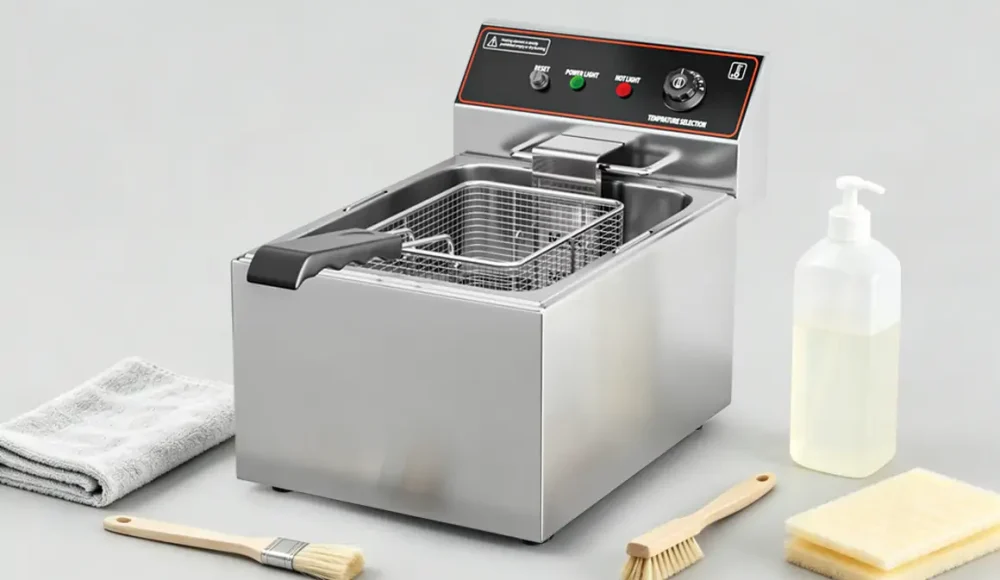
Commercial countertop electric deep fryers should be cleaned with food-safe degreasers, warm water, soft cleaning tools, and a structured maintenance process. Stainless steel surfaces should never be scrubbed with steel wool, metal brushes, or highly corrosive chemicals because these methods can damage the protective layer of the metal and shorten the equipment’s service life.
Most cleaning articles online are written from the perspective of restaurant operators. This guide is different. It is based on how a countertop electric fryer manufacturer cleans, tests, inspects, and maintains commercial fryers inside the factory before they are packed and shipped to distributors, restaurant chains, and importers around the world.As a deep fryer manufacturer China, Shangbang engineering team works with fryers every day. Production testing, quality inspection, final cleaning, packaging preparation, and after-sales technical support all provide valuable experience that goes beyond basic cleaning instructions.
Why Proper Cleaning Matters for Commercial Countertop Electric Deep Fryers?
Proper cleaning protects heating efficiency, preserves food quality, extends equipment lifespan, and reduces unnecessary service issues.Commercial fryers operate in a harsh environment. High temperatures, cooking oil, food particles, salt, seasoning residues, and moisture continuously interact with metal surfaces.
When cleaning is neglected, several problems begin to appear:
- Carbon deposits build up around heating areas
- Oil residue reduces heat transfer efficiency
- Temperature recovery becomes slower
- Food quality becomes less consistent
- Stainless steel surfaces become harder to maintain
- Oil life decreases significantly
Many operators assume fryer performance gradually declines because of age. In reality, poor cleaning habits are often responsible for much of the performance loss.From a manufacturer’s perspective, routine cleaning is one of the most cost-effective ways to protect commercial frying equipment.
Why Stainless Steel Should Never Be Cleaned with Steel Wool?
Steel wool is one of the most common causes of stainless steel damage in commercial kitchens.Many users see heavy grease deposits and immediately reach for abrasive tools. The cleaning result may appear impressive at first, but microscopic damage occurs on the surface.Commercial fryers are typically manufactured using stainless steel because of its corrosion resistance. That resistance comes from an invisible passive chromium oxide layer on the surface.
Steel wool can:
- Scratch the stainless steel surface
- Remove portions of the protective layer
- Leave tiny iron particles embedded in the metal
- Accelerate surface discoloration
- Create conditions for rust spots to appear
This is an important point that distributors frequently need to explain to their customers.Even a premium commercial fryer made from high-quality stainless steel can develop surface issues if cleaned incorrectly.The appearance of small rust spots after improper cleaning is usually not a manufacturing defect. In many cases, it is a maintenance issue caused by aggressive cleaning methods.
For this reason, Shangbang recommends:
- Soft microfiber cloths
- Nylon cleaning brushes
- Non-abrasive scrub pads
- Food-safe degreasing chemicals
These tools remove grease effectively while protecting the stainless steel finish.
What Cleaning Products Do We Use in Our Fryer Factory?
Commercial kitchen equipment manufacturers rarely rely on household cleaning products.The objective is not only to remove grease but also to protect the equipment.The cleaning products commonly used throughout the commercial foodservice equipment industry include:
Food-Safe Alkaline Degreasers
These products break down heavy grease deposits efficiently and are commonly used for fryer cleaning.
Commercial Fryer Cleaning Solutions
Professional fryer cleaning chemicals are designed specifically for cooking oil residue and carbon buildup.
Mild Detergent Solutions
For routine maintenance and final wiping procedures.
Products commonly found in commercial kitchens include:
- Ecolab fryer cleaning solutions
- Diversey commercial degreasers
- Dawn Professional Degreaser
- Similar food-safe alkaline cleaning products
Products that should generally be avoided include:
- Bleach-based cleaners
- Hydrochloric acid products
- Strong acidic cleaners
- Chloride-containing chemicals
These substances may damage stainless steel surfaces over time.
How Our Factory Cleans Commercial Electric Deep Fryers Before Shipment?
Every fryer that leaves our facility undergoes testing and inspection procedures. Cleaning forms part of that process.The procedure used inside our production facility follows a practical sequence designed to remove oils and maintain equipment condition.
Drain Residual Oil
Any oil used during testing is completely removed from the tank.
Add Warm Water
Warm water helps loosen grease deposits.
Apply Food-Safe Degreaser
Commercial-grade degreasing solution is added according to manufacturer recommendations.
Controlled Heating Process
The fryer is heated to approximately 70°C–80°C.
This temperature helps break down oil residue without creating unnecessary stress on components.
Soft Brush Cleaning
Non-metallic brushes are used to clean internal surfaces.
Thorough Rinsing
Residues from the cleaning solution are removed completely.
Drying Procedure
Equipment is air-dried before inspection.
Final Quality Inspection
The fryer is visually inspected before packaging.
This process helps ensure that products arrive clean, presentable, and ready for installation.
How Heating Helps Remove Grease More Efficiently?
Temperature plays a major role during fryer cleaning.Cooking oil behaves very differently at room temperature compared with elevated temperatures.
As oil cools:
- Viscosity increases
- Grease becomes sticky
- Deposits harden
As temperature rises moderately:
- Grease softens
- Carbonized residue loosens
- Cleaning efficiency improves
This is why professional fryer cleaning procedures often include controlled heating.The objective is not to boil the solution aggressively. The objective is to reduce grease adhesion and make cleaning easier.This principle is widely used by commercial kitchens, service technicians, and manufacturers.
Customer Case: Supporting a Distributor After Selling 500 EF018 Series Fryers
Technical support often extends beyond product manufacturing.In May 2026, one of our distributors purchased 500 units of the EF018 Series Double Tank Commercial Electric Deep Fryers for multiple restaurant customers.Several weeks after installation, the distributor began receiving questions regarding fryer cleaning procedures.
Some end users had attempted to remove heavy grease deposits using:
- Steel wool
- Metal scrapers
- Abrasive polishing pads
The result was visible scratching and discoloration on some stainless steel surfaces.A number of restaurant operators mistakenly assumed the issue was related to material quality.Our technical team reviewed the situation and determined that the equipment itself was functioning normally.
To assist the distributor, Shangbang provided:
- Cleaning procedure documentation
- Recommended degreaser guidelines
- Maintenance instructions
- Demonstration videos
- Remote technical guidance
The distributor then shared the materials with their customers.After implementing the recommended cleaning methods, customer complaints declined significantly and equipment appearance improved.This situation highlights an important reality.Many fryer-related service inquiries originate from maintenance practices rather than manufacturing defects.
How Often Should Commercial Countertop Fryers Be Cleaned?
Cleaning schedules depend on usage intensity.
A fryer operating continuously in a fried chicken restaurant will require more maintenance than one operating occasionally in a small snack shop.
Daily Tasks
- Remove food debris
- Wipe external surfaces
- Check oil condition
Weekly Tasks
- Deep clean the oil tank
- Inspect heating elements
- Remove accumulated grease
Monthly Tasks
- Inspect wiring connections
- Check thermostat performance
- Examine drain valve condition
- Review overall equipment condition
Consistent maintenance helps reduce operating costs and improve reliability.
Why Cleaning Procedures Affect Warranty and Equipment Lifespan?
Manufacturers invest considerable resources into material selection, structural design, and production quality.Improper maintenance can undermine those efforts.
Cleaning practices directly influence:
- Surface appearance
- Corrosion resistance
- Heating performance
- Temperature stability
- Service life
Many of the commercial fryers that remain in operation for years share one characteristic: consistent maintenance.From a manufacturing standpoint, preventive maintenance is always less expensive than corrective maintenance.
Watch How We Clean Commercial Electric Deep Fryers
Cleaning demonstrations often communicate procedures more clearly than written instructions.
Watch our factory cleaning and maintenance demonstrations on our YouTube channel.
You can also learn more about our manufacturing capabilities in our previous article:
How to Choose a Commercial Deep Fryer Manufacturer?
Understanding how a manufacturer builds and maintains equipment provides valuable insight into long-term product reliability.
Why Manufacturers Pay Attention to Cleaning Standards?
A professional manufacturer does not stop caring about a fryer once it leaves the factory.Equipment performance over the next three to five years directly affects customer satisfaction, repeat business, and brand reputation.
That is why experienced manufacturers focus on:
- Material selection
- Surface treatment
- Maintenance procedures
- Technical support
- Operator training
Cleaning standards are part of the overall equipment lifecycle.The goal is not only to manufacture a fryer that performs well on the first day but also to help customers maintain that performance throughout years of commercial use.