

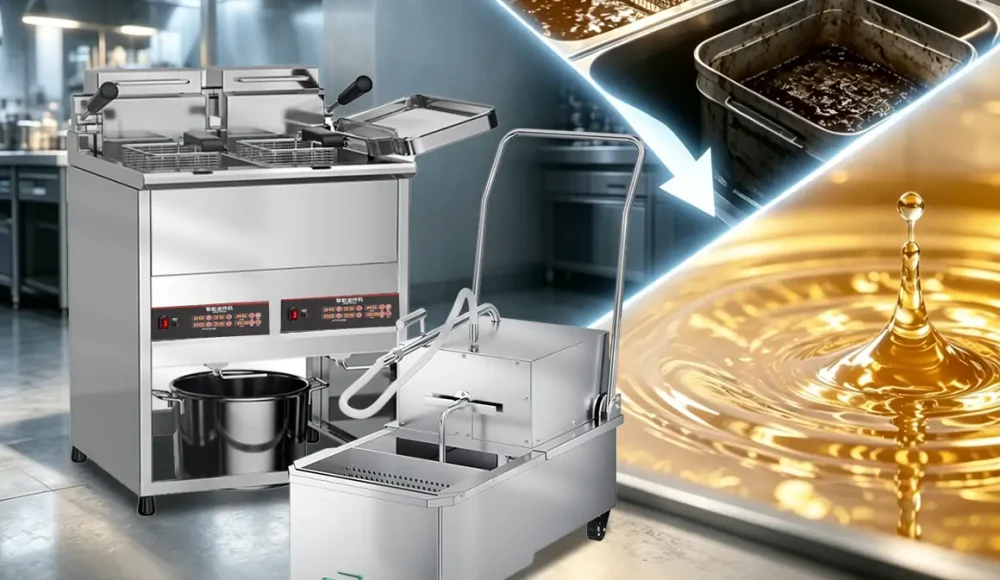
When people talk about a commercial deep fryer, most of the focus still goes to heating power, tank size, or stainless steel thickness.
But in real restaurant operations, especially for chain kitchens, central kitchens, and food truck fryer setups, the real cost driver is something much less visible — oil condition stability.
Once oil becomes contaminated with crumbs, carbon deposits, and burnt residue, everything inside the fryer starts to drift:
- oil turns darker faster
- heating becomes uneven
- temperature recovery slows down
- food quality becomes inconsistent
That’s why at Shangbang, as a commercial deep fryer manufacturer China, we don’t treat filtration as an accessory. It is part of the thermal system itself.A fryer without stable oil behavior is not a production tool — it becomes a variable system that creates unpredictable output.
How Oil Filtration Becomes Part of Heating Stability in Restaurant Fryer Systems?
In real restaurant fryer operations, oil is not just a cooking medium.It behaves like a heat transfer carrier.
When oil is clean, heat spreads evenly across the tank.
When oil is contaminated, heat transfer becomes unstable.
This is where filtration changes everything.
At Shangbang, depending on the application, we use two system approaches:
1.For high-volume chain kitchens, we integrate filtration directly into fryer design. One example is our EF002-B1 series commercial electric fryer system, which combines frying and oil circulation in a closed loop structure. This keeps oil cleaner during long production cycles and stabilizes heat behavior under continuous load.
2.For flexible setups like mobile kitchens or distributed catering, we recommend external systems such as LYC-01 and LYC-02 portable oil filter machines, which allow operators to clean oil without stopping production.
Both systems solve the same engineering problem:keeping oil stable so the heating system does not work under contaminated thermal conditions.
Oil Filtration System Comparison
| System Type | No Filtration | External Oil Filter Machine (LYC-01 / LYC-02) | Built-in Filtration (EF002-B1 System) |
|---|---|---|---|
| Oil lifespan | Short (rapid oxidation) | Medium improvement | Extended up to +50% usable cycle |
| Heating stability | Highly unstable | Improved | Fully stabilized thermal loop |
| Sediment control | None | Manual cleaning required | Continuous automatic removal |
| Food consistency | Batch variation | Improved consistency | High uniform output |
| Maintenance load | High | Medium | Low |
| Suitable for | Low-cost kitchens | Food truck fryer operations | Chain restaurants / OEM brands |
Why Oil Sediment Directly Destroys Heating Tube Performance?
This is where most buyers misunderstand fryer failure.It is not the machine that fails first.It is the oil environment that destroys the heating system.
When oil contains heavy sediment:
it forms insulation layers on heating tubes
it traps heat locally
it creates overheating zones
it accelerates carbon buildup
Over time, this leads to uneven thermal stress across the heating element.
We previously discussed in detail how sediment buildup becomes one of the main root causes of heating element failure in commercial fryer systems, and this filtration topic directly connects to that engineering logic.If that failure cycle is not controlled, even a high-end stainless steel deep fryer factory-grade product will experience performance drift.
How Shangbang Designs Filtration + Heating as One System?
At Shangbang, we never design filtration separately.It is always connected with:
heating tube layout
oil flow circulation path
temperature probe positioning
tank geometry structure
This is especially critical in double deep fryer systems, where two tanks operate under different load conditions.When oil stays clean, heating tubes operate under stable load.
This reduces:
thermal hotspot formation
heater surface carbonization
temperature sensor misread cycles
oil breakdown acceleration
That’s why systems like EF002-B1 show significantly longer stable operation cycles compared to non-filtered fryer systems.
Manufacturing Insight
In real OEM production for wholesale electric fryer supplier clients, filtration is often requested not for convenience, but for cost control.
One typical scenario we see from custom commercial fryer OEM buyers is this:
restaurants operating 10–14 hours per day
multiple frying cycles per hour
high sediment food types like chicken and fries
Without filtration, oil replacement frequency becomes a hidden cost center.With filtration, oil life can extend significantly, reducing long-term operational cost.
This is also why experienced buyers working with stainless steel deep fryer factory suppliers start prioritizing filtration systems over simple power upgrades.
Why Oil Quality Directly Impacts Heating Element Lifespan?
A fryer heating system does not operate in isolation.Oil quality determines its working condition.
Poor oil leads to:
frequent overheating cycles
thermal imbalance across heating tubes
increased mechanical stress on thermostat response
shortened component lifespan
This is exactly why filtration is not just about food quality — it directly protects the heating system.We also explored in earlier discussions how heating element design and stainless steel structure influence fryer durability, and filtration acts as the missing protection layer that extends system lifespan.
Filtration System as a Cost Control Tool
For B2B buyers evaluating a commercial fryer manufacturer China, the decision is not only technical — it is financial.
Filtration affects:
oil consumption cost
heating energy efficiency
maintenance frequency
food waste rate
When all combined, it directly changes Total Cost of Ownership (TCO).A fryer without filtration may look cheaper upfront.But over time, it becomes more expensive due to:
frequent oil replacement
higher energy consumption
faster part degradation
That’s why filtration is increasingly considered a baseline requirement for OEM commercial fryer supplier projects.
Topic-Based Engineering Connections
If you are exploring commercial fryer systems deeper, filtration connects closely with other engineering topics we’ve discussed in Shangbang’s technical breakdowns.
One related topic is how heating element failure is often caused by sediment buildup rather than manufacturing defects.
We also previously explored how choosing a reliable commercial deep fryer manufacturer in China is not just about price, but about understanding system-level engineering logic including filtration, heating, and structural design.
All these topics together form a complete fryer engineering ecosystem.
What Commercial Fryer Buyers Should Understand
Most buyers searching for “best commercial fryer” are actually solving three hidden problems:
reducing oil cost
maintaining consistent food quality
stabilizing multi-location operations
But the real engineering truth is simple:
A fryer is not just a heating machine
It is a thermal circulation system
Oil filtration is part of that system stability
That is why serious OEM buyers, wholesalers, and restaurant chains now evaluate filtration as a core specification — not an optional feature.
FAQ
Does oil filtration really extend fryer lifespan?
Yes. It reduces sediment buildup, which directly protects heating elements and stabilizes thermal load.
What is better, built-in filtration or external filter machine?
Built-in systems are ideal for high-volume kitchens, external systems are better for flexible or mobile setups.
Why does oil get dirty so fast in commercial fryers?
High temperature frying creates carbonized residue, especially with breaded or frozen food.
Is filtration necessary for small restaurant fryer setups?
Yes, even small systems benefit from reduced oil consumption and stable heating performance.
How does filtration affect food quality?
Cleaner oil ensures consistent frying color, texture, and reduces batch variation.