

Simple answer: whether a commercial deep fryer can run stably for 6–16 hours of continuous food production does not depend on the outer structure, oil tank size, or even power rating.It depends on whether every internal component is actually designed to match real commercial kitchen workload.
If critical parts like the thermostat, heating element, and temperature probe do not have enough durability, the result is not a sudden machine failure.It is a gradual system breakdown:
- oil temperature starts drifting
- oil degrades faster than expected
- food quality becomes inconsistent
- staff need to constantly adjust operations
For any restaurant deep fryer system, this is not just an equipment issue — it becomes a system-level cost increase across the entire kitchen operation.
That is exactly why, at Shangbang (Guangzhou Shangbang Commercial Electrical Equipment Co., Ltd.), we treat component lifespan as the core engineering foundation of every commercial electric fryer we design, not just an accessory specification.
In real B2B procurement decisions, especially for OEM commercial fryer supplier projects and wholesale electric fryer sourcing, this factor directly determines long-term ROI, maintenance cost, and kitchen stability.
How Component Lifespan Directly Impacts Commercial Deep Fryer Performance in Real Kitchens?
In a commercial fryer system, performance is not defined by specs on paper.It is defined by how long the system can maintain stability under continuous frying.
For example, a commercial electric fryer working in a food truck fryer environment is exposed to:
- constant oil temperature cycling
- batch loading of frozen food
- long operating hours without cooling cycles
- fluctuating power load
If component lifespan is not matched to this environment, even a high-end electric deep fryer starts losing stability.
This is why wholesalers and OEM buyers often shift toward a stable commercial fryer factory instead of low-cost sourcing.Because in real kitchens, instability always turns into operational cost.
How Shangbang Engineers Component Lifespan Based on Real Commercial Kitchen Load Conditions?
At Shangbang, a commercial electric fryer is never designed as a single product.It is designed as a load system.We match component lifespan based on:
- restaurant deep fryer usage intensity
- frying cycle frequency
- oil temperature recovery speed
- batch size per hour
- OEM or wholesale electric fryer distribution model
This is why two identical-looking fryers can have completely different lifespans.For example:
- same stainless steel deep fryer structure
- same power rating
- different internal load engineering
The result is completely different operational durability.This is also the key reason many OEM commercial fryer supplier projects require customization instead of standard models.
Why Fryer Failure Is Usually Not Breakdown, but Engineering Mismatch Over Time?
Most buyers assume fryer failure means “broken equipment”.But in real manufacturing experience, especially in commercial fryer manufacturer China production cases, failure usually happens in a different way.
It is not breakdown.It is mismatch between:
- component lifespan
- real kitchen workload
- thermal cycling intensity
When mismatch happens:
- heating becomes unstable
- oil degrades faster
- fryer output becomes inconsistent
- operators start adjusting manually
This is especially visible in commercial double deep fryer systems used in chain restaurants.The machine still runs, but performance becomes unpredictable.
Key Internal Components Inside a Commercial Electric Fryer and Their Lifecycle Roles
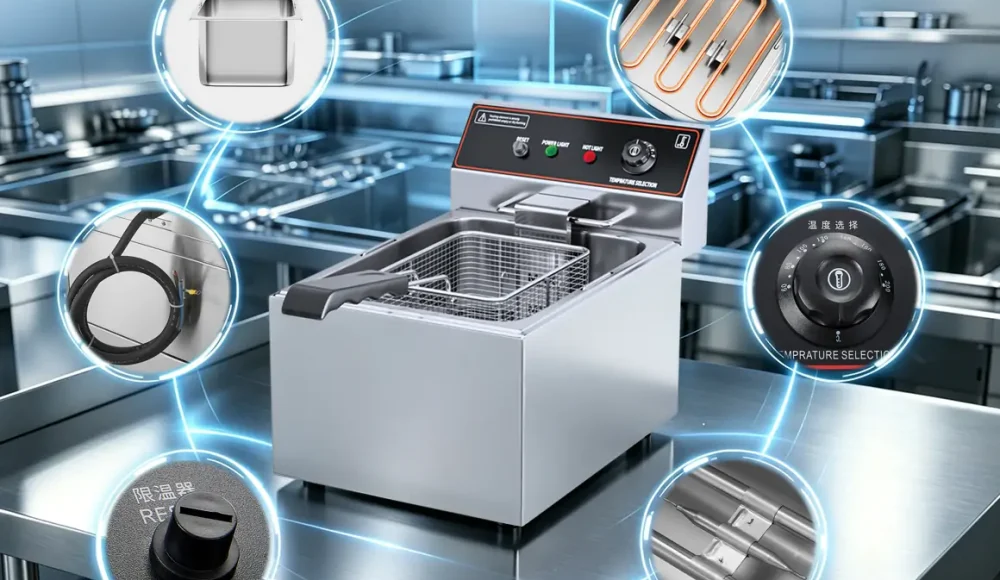
A typical commercial electric fryer structure (like EF017 series) includes:
- stainless steel tank structure
- heating tube system
- thermostat module
- thermal probe sensor
- safety limiter
- power supply system
- indicator system
From a stainless steel deep fryer factory perspective, each of these components has a different lifespan curve,and more importantly, they interact with each other.
If one weak point appears,the entire system stability drops.This is why OEM commercial fryer supplier engineering always focuses on system balance instead of isolated parts.
How Temperature Control Stability Extends or Reduces Component Lifespan in Fryer Systems?
Temperature control is not only about food quality.It directly determines how long each component survives.When temperature is unstable:
- heating tubes over-cycle
- thermostats constantly correct
- oil oxidation accelerates
- system runs under stress
This is also closely related to topics discussed in commercial fryer manufacturer engineering insights — where temperature stability is identified as a core cost driver, not just a feature.
Stable temperature = lower system stress,unstable temperature = faster component aging.That’s the real engineering difference.
Stainless Steel Thickness vs Thermal Fatigue: What Actually Determines Long-Term Durability
Many buyers focus on stainless steel thickness when choosing a commercial fryer,but in real engineering, thickness alone does not define lifespan.What matters more is thermal fatigue behavior.
If design is not balanced:
- heat accumulates in certain zones
- expansion stress increases
- weld points fatigue faster
- structure deformation begins over time
That is why a stainless steel deep fryer factory must design both material and thermal flow together,not separately.
Factory-Level Lifespan and Load Testing in Commercial Fryer Manufacturing
Before shipment, Shangbang tests every commercial electric fryer under simulated kitchen conditions.We replicate:
- continuous frying cycles
- frozen food load impact
- oil temperature recovery cycles
- long-hour thermal drift
Because real failures usually appear after hours of continuous operation, not during short inspection tests.This is also a key reason OEM buyers trust factory-level testing instead of supplier claims.
Real Case Study: Why Experienced Buyers Switch to OEM Commercial Fryer Manufacturers
A typical case involves experienced wholesalers and restaurant operators who previously worked with trading companies instead of a direct commercial fryer factory.
Their problems usually look like:
- inconsistent batch performance
- frequent maintenance cycles
- unstable fryer output
- rising oil cost
After switching to a structured OEM system, they usually realize:equipment stability affects business stability more than price difference.This shift is especially common in food truck fryer supplier procurement cases.
Component Lifespan as the Core Driver of Total Cost of Ownership (TCO) in Fryer Systems
In commercial fryer systems, cost is not purchase price.It is total operational cost.Including:
- oil consumption
- maintenance frequency
- downtime cost
- replacement cycle
- labor correction time
If component lifespan is short, TCO increases dramatically.This is why serious buyers compare systems, not just units.
How Different Commercial Kitchen Environments Affect Fryer Component Lifespan?
Component lifespan changes depending on:
- continuous operation time (6–16h)
- oil quality and replacement cycle
- cleaning frequency
- kitchen temperature
- operator habits
For example, a restaurant deep fryer in a high-volume chain behaves very differently from a small countertop electric fryer in a cafe.Same machine, different environment, different lifespan curve.
Engineering Connections Across Commercial Fryer Systems: Heat, Oil, Structure, and Maintenance
To fully understand commercial fryer systems, component lifespan connects with several engineering topics:
When oil residue builds up, heating tubes are affected — which is closely related to cleaning structure design and sediment management inside the tank.
When welding quality is poor, oil leakage and buildup accelerate internal corrosion — a topic often discussed when analyzing stainless steel deep fryer factory manufacturing quality.
And when buyers evaluate suppliers, they usually revisit how to identify a reliable commercial fryer manufacturer China — because supply consistency directly affects component quality consistency.
These topics together form a complete procurement logic, not isolated knowledge.
What Buyers Must Understand About Component Lifespan When Choosing a Commercial Fryer Manufacturer?
Most buyers searching for commercial deep fryer or commercial fryer solutions are actually trying to solve three problems:
- stable output consistency
- lower oil consumption
- scalable kitchen operations
But the real truth is simple:
fryer performance is not a single component issue
it is a system-level engineering problem
That is why OEM buyers, wholesalers, and brand owners usually prioritize factories that control:
- thermostat calibration systems
- heating tube engineering
- structural design stability
- export certification capability
FAQs
What determines commercial deep fryer lifespan most?
Component quality and system-level thermal balance under real load.
Why do fryers fail slowly instead of suddenly?
Because degradation happens through thermal fatigue and mismatch, not instant breakdown.
Is stainless steel thickness the main factor?
No, system engineering and heat distribution are more important.
Why do OEM buyers prefer factory suppliers?
Because factories can control component matching and lifespan design.
How can restaurants extend fryer lifespan?
Proper cleaning, stable temperature control, and correct oil usage management.