

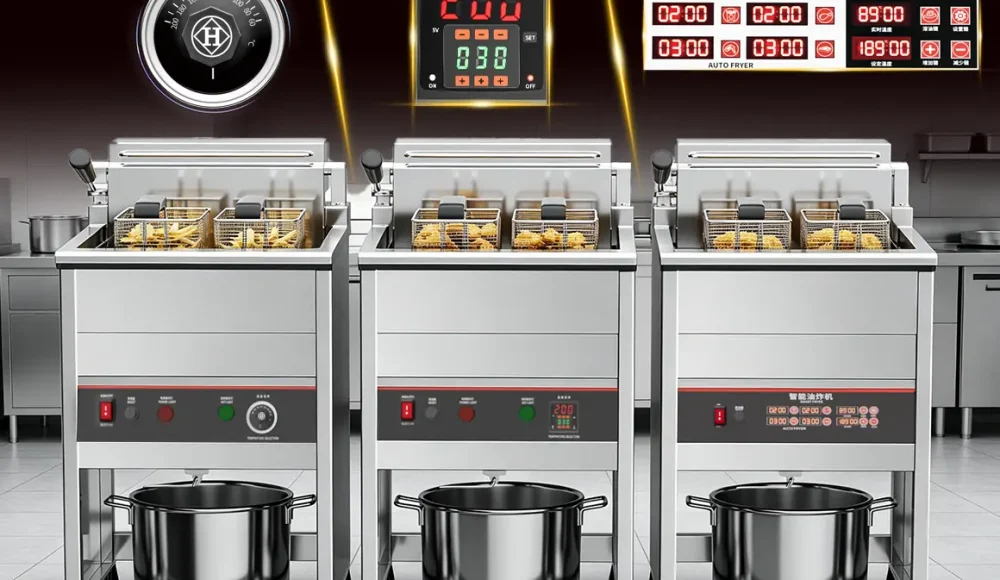
If we strip away marketing language, the real cost driver of a commercial deep fryer is not size, stainless steel thickness, or even wattage.
It is temperature control stability under continuous commercial load.
Once a fryer cannot maintain oil within a tight range (usually ±2°C), everything in a restaurant deep fryer system starts to break down — oil degrades faster, food output becomes inconsistent, and operators begin manual correction.
This is where most buyers of a commercial fryer manufacturer China realize the difference between a cheap machine and an engineered system.
At Shangbang, every commercial electric fryer we design is built around one principle:
temperature control is not a feature, it is the core system of the fryer.
Why Temperature Control Matters More Than Size or Power in a Commercial Deep Fryer?
Most buyers entering the market for a commercial fryer factory or wholesale electric fryer supplier usually focus on:
- large deep fryer capacity
- stainless steel deep fryer thickness
- countertop electric fryer size
- commercial fryer wattage
But in real operation, especially for food truck fryer supplier projects and chain restaurants, these factors are secondary.
What actually determines output stability is how the fryer behaves under real load:
- continuous frying cycles (6–16 hours)
- frozen food batch loading
- oil recovery after food drops
- operator variability in kitchen environments
If temperature swings are too wide, even a premium electric deep fryer becomes unstable.
At that point, production becomes operator-dependent instead of system-controlled — and that directly impacts profit margin.
Factory-Level Temperature Testing in a Commercial Fryer Manufacturer System
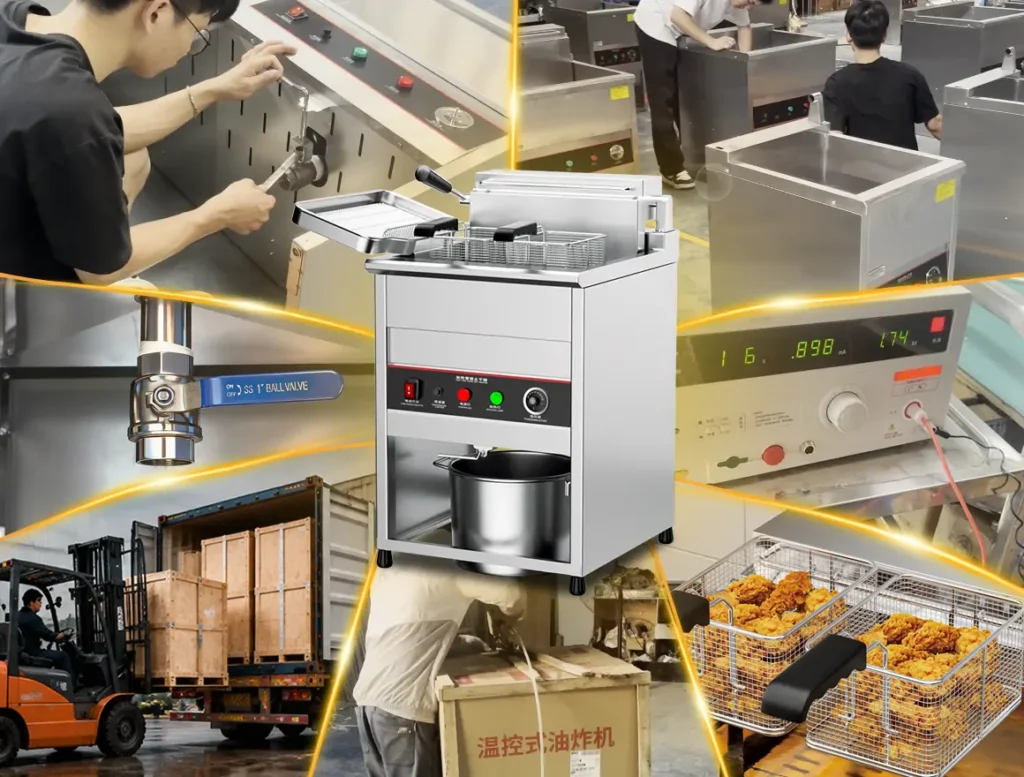
Before any commercial electric fryer leaves a professional factory, it should never be tested only as a “power-on inspection”.
At a real commercial fryer manufacturer in China, the system is tested under simulated kitchen conditions:
- long-cycle continuous frying simulation
- oil recovery after frozen food insertion
- high-load restaurant fryer operation modeling
- long-duration thermal drift tracking
This is essential because many failures in a stainless steel deep fryer factory only appear after hours of continuous operation, not during short checks.
This is also a key reason why professional buyers working with an OEM commercial fryer supplier prioritize system validation instead of surface-level inspection.
Real Case Insight: Why a German Chain Switched OEM Commercial Fryer Supplier?
A German chain restaurant contacted us after facing serious consistency issues across multiple stores.
They were using a low-cost commercial electric fryer, but their problem was not obvious at first.
Same recipe.
Same frying time.
Different output quality.
Some batches were undercooked, others overcooked.
After testing their equipment, we found:
- uneven heating tube distribution
- unstable thermal response system
- poor oil temperature balance across tank
This is a common issue in low-cost commercial fryer supplier systems where design is optimized for cost, not stability.
After switching to Shangbang production, they ordered 30 units of EF001-JX06 commercial electric fryer system for rollout across multiple stores.
What changed was not just equipment — it was production consistency across their entire restaurant network.
That is the real difference between a low-cost fryer and a scalable restaurant deep fryer system.
How Temperature Control Affects Commercial Deep Fryer Cost Structure
For any commercial fryer factory, temperature control directly impacts three cost layers:
1. Oil Consumption Cost
Unstable heating leads to:
- faster oil oxidation
- repeated heating cycles
- reduced oil lifespan
In real kitchens, this increases oil cost by 20–40% annually.
2. Food Quality and Waste
In a restaurant fryer environment:
- chicken becomes inconsistent (burnt outside, raw inside)
- fries lose crisp structure
- batch variation increases return rate
This is especially critical for commercial chicken deep fryer applications and chain restaurants.
3. Labor Efficiency
A stable commercial electric fryer reduces:
- manual temperature checking
- operator adjustments
- batch correction work
Unstable systems increase labor dependency and slow down workflow efficiency.
Commercial Deep Fryer Temperature Control Comparison
When we talk about temperature control in a commercial deep fryer, the real difference is not “mechanical vs digital”.
In real procurement decisions, especially for OEM buyers, wholesalers, and restaurant chains, the real gap is:
low-cost generic thermostat systems vs industrial-grade temperature control systems used by professional commercial fryer manufacturers like Shangbang.
Most buyers only realize this difference after production instability starts showing up in kitchens.
Temperature Control System Comparison (Real Engineering Difference)
| Performance Factor | Low-Cost Generic Temperature Control System | Shangbang Commercial Deep Fryer Control System |
| Temperature stability | ±5°C to ±10°C fluctuation during operation | Controlled within ±2°C range under continuous load |
| Heating response speed | Slow recovery after food is dropped | Fast thermal recovery system designed for batch frying |
| Oil temperature consistency | Drops sharply during high-load frying | Maintains stable frying curve during continuous operation |
| Sensor accuracy | Basic probe, limited calibration | Industrial-grade sensing system with factory calibration |
| Heating distribution | Uneven heat zones inside oil tank | Balanced heating tube layout with optimized thermal spread |
| Long-hour operation stability (6–16h) | Temperature drift increases over time | Stable output across long continuous frying cycles |
| Oil degradation speed | Faster oxidation due to overheating cycles | Reduced oil breakdown with stable thermal control |
| Batch consistency | High variation between frying batches | Uniform output across multiple batches |
| Maintenance frequency | High (frequent recalibration or replacement) | Low maintenance design with stable long-term performance |
| Suitable application | Small low-cost kitchen setups | Restaurant chains, OEM brands, food trucks, wholesale electric fryer |
How to Interpret This in Real Procurement Decisions?
Most buyers misunderstand temperature control.
They assume it is just a dial accuracy issue.
But in real commercial deep fryer manufacturer engineering, it is a system behavior under continuous load, not a single component.
Low-cost systems fail because:
- temperature drops too fast when food is added
- recovery speed is unstable
- heating distribution is uneven
- sensor readings drift under long operation
This creates the typical complaints from restaurant operators:
- “same recipe, different result”
- “first batch fine, second batch inconsistent”
- “oil gets dirty too fast”
- “machine looks fine but output is unstable”
Heating Element Design: Core of Every Electric Deep Fryer System
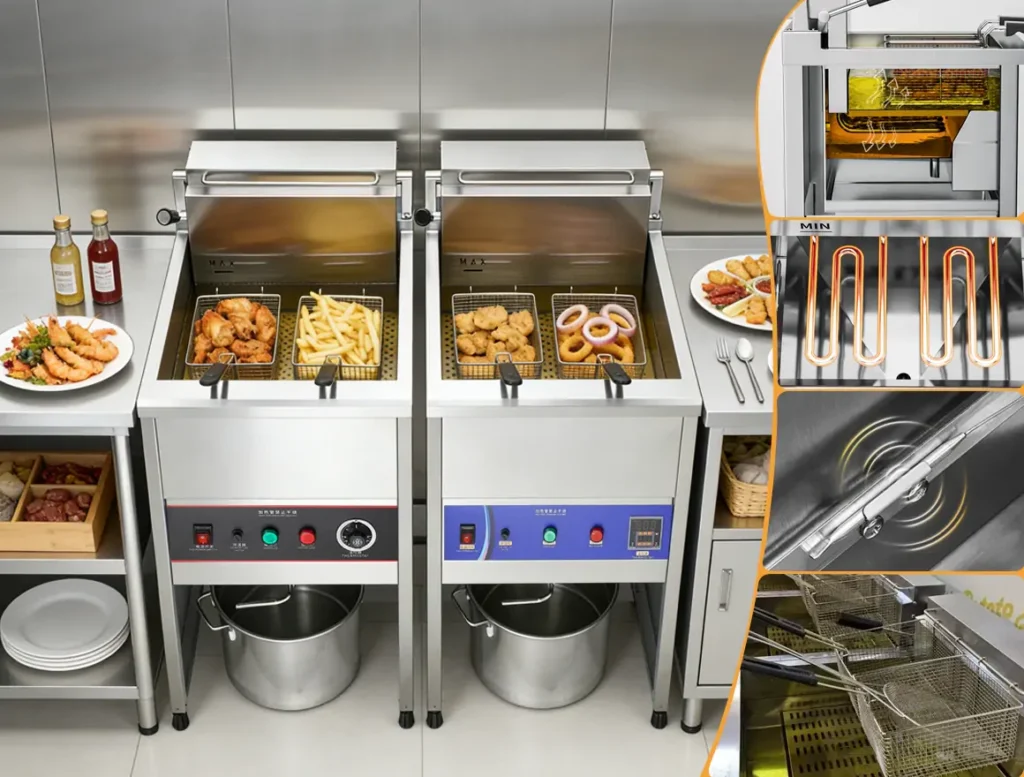
A commercial electric fryer is only as stable as its heating tube system.
Key engineering factors:
- heating density distribution
- stainless steel heating tube quality
- oil circulation flow pattern
- recovery speed after batch loading
If heating is uneven:
- hot spots form in oil
- food burns locally
- temperature sensors become misleading
This is why sourcing from a real stainless steel deep fryer factory matters more than comparing specs.
Choosing the Right Commercial Deep Fryer Is Always a Scenario Decision
If you are comparing commercial deep fryer suppliers, the real decision should not be:
- price difference
- size difference
- power difference
The real decision is:
whether the temperature control system is engineered for continuous commercial load stability
That is the dividing line between:
- unstable low-cost fryer sourcingvs
- scalable commercial fryer manufacturing system
Heating Element Design: The Hidden Core of Fryer Performance
A commercial electric fryer is only as stable as its heating tube system.
Key engineering factors include:
- heating density distribution
- stainless steel heating tube quality
- oil circulation flow pattern
- recovery speed after food loading
If heating is uneven:
- hot spots form inside oil
- food burns locally
- temperature sensor gives misleading readings
That’s why sourcing from a real factory matters more than comparing specs alone.
Choosing the Right Commercial Deep Fryer Is Always a Scenario Decision
There is no universal “best fryer”.
Different buyers need different configurations:
- OEM brands focus on structure customization and batch stability
- restaurant chains prioritize consistency across multiple machines
- wholesalers focus on certification and long-term supply reliability
That’s why at Shangbang, we don’t treat fryer selection as product-based.
We treat it as application-based engineering matching.
What Buyers Should Really Understand
Most buyers searching for “best commercial fryer” are actually solving three problems:
- consistency across batches
- reducing oil cost
- scaling operations
But the real truth is simple:
A fryer is not a single product
It is a thermal engineering system
That is why serious buyers choose:
- commercial fryer manufacturer
- OEM commercial fryer supplier
- custom commercial fryer OEM
- wholesale electric fryer supplier
- factory direct commercial fryer solutions
FAQs
What temperature range is best for commercial deep frying?
Most applications run between 160°C–180°C depending on food type.
Why does oil degrade faster in some fryers?
Usually due to unstable temperature cycles and overheating.
Is stainless steel thickness related to temperature stability?
Indirectly yes, but heating system design is more important.
What matters more for OEM fryer sourcing?
System stability, not just machine specification.
What affects fryer lifespan the most?
Heating system quality, thermostat stability, and maintenance habits.