

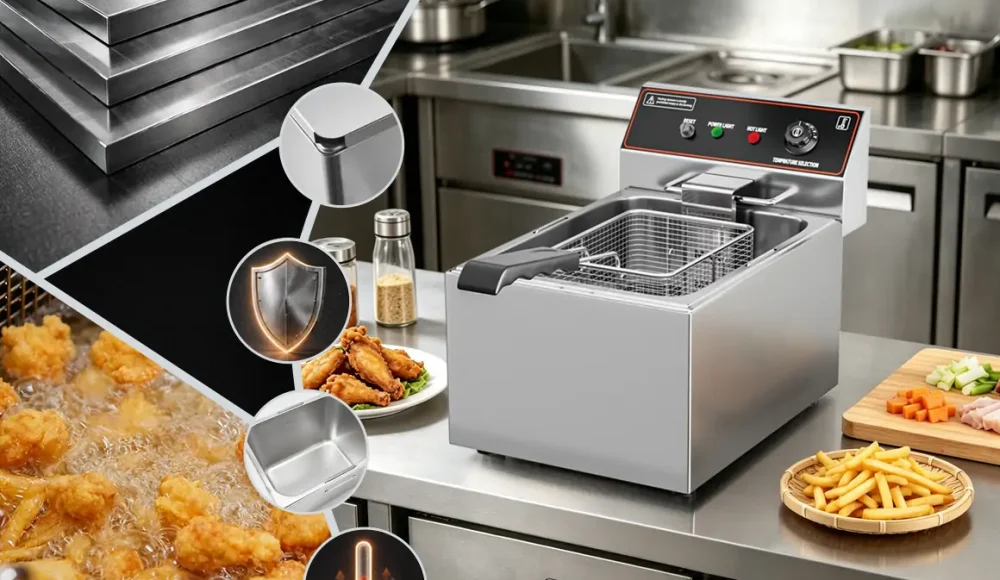
In commercial kitchens, a deep fryer is not just equipment—it is a daily production asset running 6 to 16 hours without stopping. For a commercial electric deep fryer manufacturer, one of the most underestimated but decisive factors is stainless steel thickness and material selection.
Most buyers focus on price, basket size, or heating speed. But for a commercial deep fryer factory producing thousands of units for restaurants, distributors, and OEM brands, the real difference in long-term performance usually comes from something invisible at first glance: steel gauge and material structure.
At Shangbang (Guangzhou Shangbang Commercial Electrical Equipment Co., Ltd.), we’ve seen cases where two machines look identical on day one, but after 6–12 months of commercial use, their lifespan diverges dramatically. The reason is almost always material thickness and welding structure—not heating power or control system.
Stainless Steel Thickness in Commercial Electric Deep Fryer Manufacturing
In commercial fryer production, stainless steel is not just a material—it is the structural foundation of the entire machine.
A commercial electric deep fryer manufacturer in China typically uses different gauges depending on cost positioning. In real industrial production, 18 gauge and 16 gauge stainless steel behave completely differently under heat expansion, oil pressure, and continuous frying vibration.
A thinner stainless steel body may look acceptable in small kitchen usage, but under high-frequency restaurant operations, metal fatigue begins to appear. This is especially visible around oil tanks, welding seams, and heating chamber supports.
Thicker stainless steel, especially food-grade 304 used in high-end OEM fryer manufacturing, provides better deformation resistance and significantly reduces long-term leakage or structural warping.
This is exactly why B2B buyers sourcing from a commercial fryer factory China must evaluate material thickness as part of ROI calculation, not just unit price.
Why We Rarely Receive Corrosion Complaints from B2B Buyers?
One of the most consistent feedback patterns from our global distributors is the lack of corrosion-related complaints.
This is not accidental.
In commercial fryer manufacturing, corrosion is usually caused by three factors:
- thin stainless steel reacting faster to oil acids
- poor welding sealing at joints
- low-grade surface polishing treatment
At Shangbang, our commercial stainless steel electric fryer OEM production line is designed to minimize these risks from the structural level.
Even in high-moisture, high-oil environments like fried chicken kitchens or food trucks, properly selected stainless steel thickness significantly extends machine life.
Many clients compare our units with lower-cost suppliers and initially choose cheaper options. However, after transportation vibration, long-term heat exposure, and daily cleaning cycles, thin steel units often show deformation or oil tank distortion.
This is not a design flaw—it is a material decision.
Cost vs Durability: Should You Choose Thicker Steel or Lower Price?
In OEM commercial fryer procurement, this is one of the most important decision points.
A commercial deep fryer supplier can always reduce cost by lowering steel thickness. On paper, the fryer still works. It heats oil, fries food, and passes basic testing.
But in real restaurant conditions, the equation changes:
- 12–16 hours daily heating cycle
- constant oil pressure inside tank
- repeated basket movement impact
- cleaning chemical corrosion
Under these conditions, thin steel becomes a hidden maintenance cost.
For brand owners and wholesalers, fewer failures mean fewer returns, fewer warranty claims, and more stable downstream distribution.
That is why experienced buyers working with a commercial deep fryer manufacturer China OEM factory often prioritize durability over initial cost savings.
Manufacturing Reality: Gauge Difference in High-Temperature Oil Systems
In industrial fryer engineering, gauge thickness affects:
- deformation resistance under 180–200°C oil
- welding joint stability
- heat expansion tolerance
- vibration resistance during transport
For example, 16 gauge stainless steel provides significantly better structural stability compared to 18 gauge in continuous frying environments.
This becomes even more important in commercial double deep fryer systems, where both tanks operate independently but share the same structural frame.
At Shangbang, we design our fryer frames based on long-cycle stress testing rather than only initial performance output.
Real Case: Why One Philippine Brand Switched to Our Manufacturing (2024–2025)
At the 2024 Guangzhou Canton Fair (Pazhou Exhibition), we met a Philippine brand owner who was sourcing from multiple OEM factories.
Initially, he chose a Zhejiang supplier because of lower pricing. The samples looked acceptable, and early orders were placed.
However, during logistics and distribution testing, problems appeared:
- stainless steel side panels dented during shipping
- slight deformation after stacking in containers
- inconsistent structural rigidity between batches
By 2025, during another exhibition visit, he returned to compare suppliers again.
This time, he visited our factory in Guangzhou and inspected material thickness, welding structure, and production process.
After evaluation, he switched to Shangbang and placed:
- 800 units/month EF017-A commercial fryer
- additional double tank fryer orders
- matching warming equipment sets
The key reason was not pricing—it was structural reliability.
This case is also referenced in our earlier article:
How to Choose a Reliable Commercial Deep Fryer Manufacturer in China (2026 Guide)
Recommended Product: EF011-A Series Countertop Commercial Fryer
For buyers who want a balance between cost efficiency and durability, we recommend:
EF011-A countertop commercial electric deep fryer series
This model uses reinforced stainless steel structure designed for:
- snack bars
- fast food shops
- small restaurant kitchens
- food trucks
It is also widely used by distributors who want stable OEM private label fryer supply.
👉 Internal link: EF011-A product
Key advantages:
- stable heating system
- reinforced tank structure
- OEM customization available
- suitable for 6–12 hour daily operations
Why does stainless steel thickness matter in commercial deep fryer manufacturing?
Because it directly affects durability, deformation resistance, and long-term safety. In high-temperature oil environments, thin steel can warp, leak, or fatigue over time.
Why do some fryers fail after 6–12 months of use?
Most failures are not heating-related. They are caused by structural fatigue, thin steel panels, welding weakness, and repeated thermal expansion in commercial environments.
Is thicker stainless steel always better for commercial fryers?
In most B2B restaurant and OEM applications, yes. But it must be balanced with cost positioning and product category (light duty vs heavy duty fryer systems).
What do manufacturers usually not tell buyers?
Many low-cost suppliers reduce steel thickness to lower price while keeping outward appearance similar. This affects long-term reliability but is not visible during sample testing.
FAQ
What stainless steel is best for commercial deep fryer manufacturing?
Food-grade 304 stainless steel is the most commonly used for durability and corrosion resistance.
Does thicker steel improve fryer lifespan?
Yes, it reduces deformation and extends service life under continuous commercial use.
Can thin steel fryers be used for restaurants?
Only for light-duty usage. Not recommended for high-volume kitchens.
Does Shangbang support OEM stainless steel customization?
Yes, we support 304 and 316 full-body customization for OEM clients.