

Restaurant kitchens run very differently depending on production scale, menu structure, and peak-hour pressure. Choosing the right fryer size is not just about capacity—it directly affects output speed, energy usage, and long-term profitability.
For buyers searching terms like deep fryer manufacturer China, commercial fryer factory, OEM commercial deep fryer, or commercial electric fryer supplier, fryer sizing is usually the first real decision before purchasing equipment.
Getting it wrong usually means one of two problems:
too slow during rush hours, or too expensive to operate daily.
Fryer Size and Real Kitchen Output (Practical Guide)
Instead of thinking in theory, most commercial kitchens choose fryer size based on real order volume and workflow.
| Business Type | Recommended Fryer Capacity | Typical Peak-Hour Output | Recommended Configuration |
| Food Truck | 6L–10L | 15–25 Orders | Countertop Electric Fryer |
| Cafe & Snack Shop | 10L–15L | 25–40 Orders | Single Tank Fryer |
| Burger Restaurant | 15L–22L | 40–70 Orders | Double Tank Fryer |
| Fried Chicken Shop | 22L–30L | 70–120 Orders | High-Power Electric Fryer |
| Restaurant Chain | 30L+ | 120+ Orders | Multi-Tank Frying System |
| Central Kitchen | 40L–80L+ | 300+ Orders | Industrial Fryer System |
This kind of capacity planning is commonly used by commercial deep fryer manufacturer China factories when designing OEM solutions for restaurant chains and distributors.
Factory Visit Case Study: Fryer Capacity Planning for a Six-Store Restaurant Chain in the United States
Choosing the right electric fryer size is one of the most important decisions for commercial kitchens. Capacity directly affects production speed, oil efficiency, labor cost, and peak-hour stability. A wrong choice often leads to either wasted energy or insufficient output during rush hours.
A real project in 2025 shows how fryer sizing decisions affect actual restaurant performance.
A U.S. client named Frank, who runs a growing fried food chain, visited Guangzhou Shangbang Commercial Electrical Equipment Co., Ltd. to plan equipment for six stores.
Instead of buying standard models, the goal was clear:
build a consistent frying system across different store types.
High-Volume Stores (Busy City Locations)
These stores were located in high-traffic commercial areas.
They required:
1.Continuous frying during peak hours
2.Fast recovery between batches
3.Stable output for fried chicken and fries
Final configuration:
22L Commercial Electric Deep Fryer × 3 Units
Why this setup works:
1.Larger oil volume prevents temperature drops
2.High-power heating supports continuous frying
3.Multiple units avoid production bottlenecks
This type of setup is commonly recommended for commercial fryer manufacturer China clients serving fast food chains.
Medium-Traffic Stores (Suburban Locations)
These stores had more stable daily traffic and lower peak pressure.
Main needs:Balanced production and cost control,Flexible menu operation,Lower oil consumption
Final configuration:
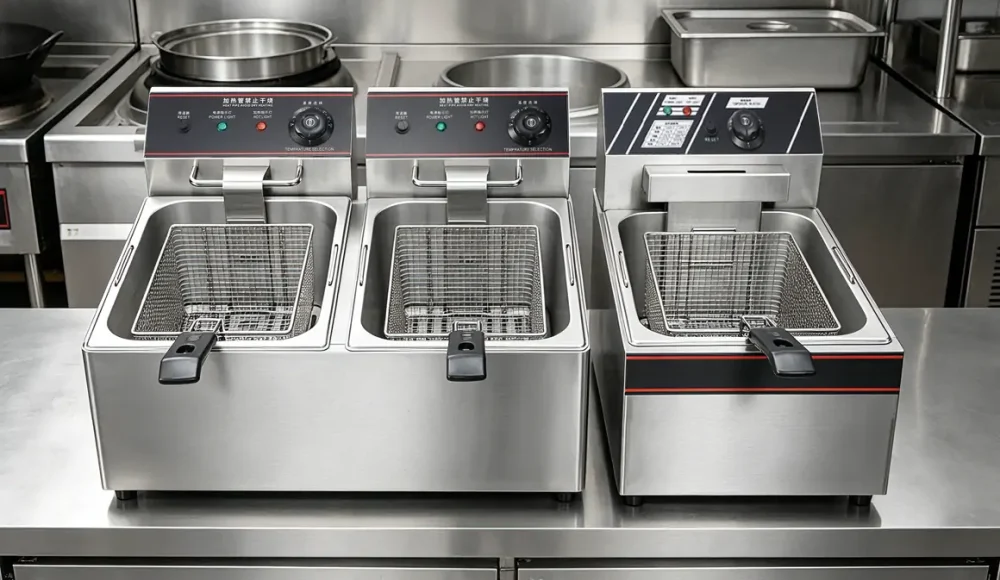
15L Double Tank Electric Fryers
Why this works:
1.Separate tanks allow parallel frying
2.Reduces flavor mixing between foods
3.Saves oil during off-peak hours
4.Easier cleaning and maintenance
This configuration is widely used by commercial kitchen fryer manufacturer projects for franchise systems.
Fryer Capacity vs Production Output Comparison
One of the most common mistakes made by restaurant buyers is selecting fryer size based solely on oil tank volume.
Production capacity depends on multiple factors:
| Factor | Real Impact |
| Oil Capacity | Batch size per cycle |
| Heating Power | Recovery speed during peak hours |
| Basket Size | How much food per cycle |
| Temperature Stability | Product consistency |
| Food Type | Cooking time variation |
| Operator Workflow | Overall kitchen throughput |
For example, a 22L fryer equipped with a high-power heating system may outperform a larger low-power fryer during continuous service periods.
Professional commercial fryer manufacturers evaluate the entire frying system rather than focusing on tank volume alone.This is why a custom commercial fryer manufacturer does not just sell size options—they design full production systems.
Why Restaurant Chains Often Choose Different Fryer Sizes for Different Locations?
Large restaurant groups rarely deploy identical fryer models across every store.
Equipment selection is usually based on:
- Store revenue
- Seating capacity
- Delivery volume
- Product mix
- Local demand
Many successful restaurant chains combine:
- High-traffic stores → 22L+ high-power systems
- Medium stores → 15L dual-tank fryers
- Central kitchens → 30L+ floor-standing fryers
within the same organization.
This strategy maximizes capital efficiency while maintaining consistent food quality.
OEM Commercial Fryer Solutions for Growing Restaurant Brands
As restaurants scale, off-the-shelf equipment often stops fitting operational needs.
That’s where OEM support from a deep fryer factory China becomes important.
Typical customization options include:
Electrical configuration:110V / 220V / 380V systems
Branding:
1.Logo engraving
2.Private label packaging
3.Control panel customization
Structure customization:
1.Tank size adjustment
2.Basket design optimization
3.Drainage and oil filtration systems
Compliance support:CE / RoHS / CCC / CQC
These solutions are especially important for private label deep fryer manufacturer and distributor projects.
Commercial Fryer Size Selection Checklist
Before choosing equipment, experienced buyers always check:
- Peak-hour order volume
- Daily frying output
- Menu complexity
- Kitchen space layout
- Power supply stability
- Future expansion plans
- Oil replacement strategy
This is exactly how commercial electric fryer supplier factories recommend capacity matching for OEM clients.
How Fryer Selection Influences Restaurant Profitability?
The impact of fryer selection extends far beyond cooking performance.
Incorrect fryer sizing can increase:
- Oil consumption
- Energy cost
- Labor cost
- Customer waiting time
- Maintenance frequency
A properly matched commercial electric fryer improves:
- Production efficiency
- Oil lifespan
- Kitchen workflow
- Customer satisfaction
- Profit margins
Restaurant owners evaluating new equipment should also review:
How the Right Commercial Electric Fryer Boosts Restaurant Profitability: A Complete Buyer’s Guide for 2026
Understanding profitability and fryer sizing together provides a more complete equipment purchasing strategy.
Frequently Asked Questions
How do I calculate the correct fryer capacity?
Capacity should be determined by peak-hour production volume, menu complexity, batch size, and future business growth rather than kitchen dimensions alone.
Is a double-tank fryer better than a single-tank fryer?
Double-tank fryers allow simultaneous cooking of different food categories, improve workflow efficiency, and reduce flavor transfer between products.
What fryer size is recommended for fried chicken restaurants?
Most fried chicken restaurants select 22L–30L commercial electric fryers because they provide strong recovery performance and support continuous operation.
Can OEM fryer manufacturers customize fryer specifications?
Yes. OEM commercial fryer manufacturers can customize voltage, power, basket size, tank dimensions, branding, packaging, and control systems.
Why buy directly from a commercial fryer factory in China?
Direct cooperation with a commercial deep fryer factory can lower procurement costs, improve customization options, and provide long-term technical support.